Nasturtium majus
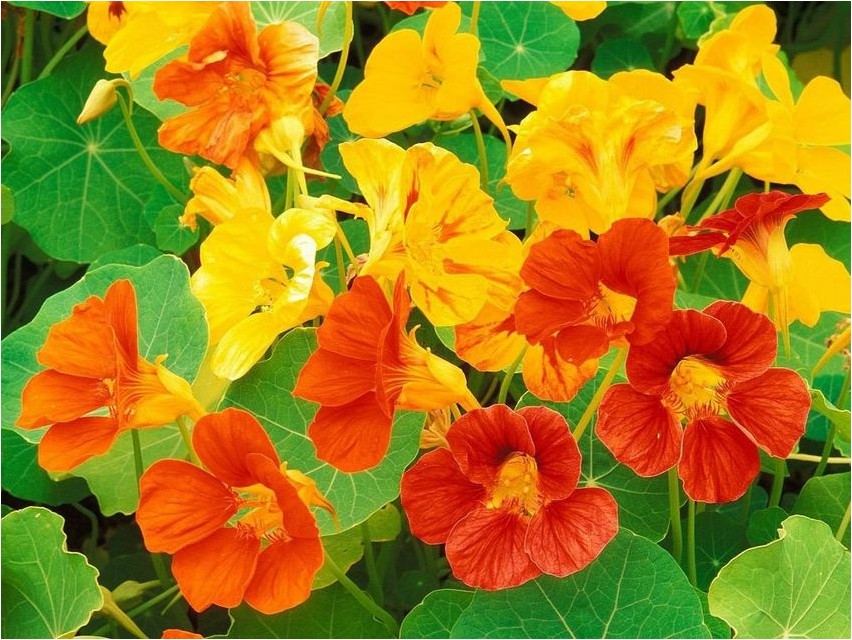
Nasturtium majus is a member of the nasturtium family, and its Latin name is Tropacolum majus L.
The Latin name for the nasturtium family is Tropacolaceae.
Description of Nasturtium majus
Nasturtium majus is also known by the following common names: capuchin, colored salad, garden nasturtium, and bellflower. Nasturtium majus is an annual herbaceous plant, growing between ten and forty centimeters in height. This plant bears long-petioled flowers with a spur. The flowers are quite large, and their color ranges from fiery red to orange. The sepals of nasturtium majus are the same color as the corolla and contribute to the formation of a fairly large spur. This plant has only eight stamens, and the pistil has a superior three-locular ovary. The fruit of the large nasturtium will disintegrate into three fairly large, single-seeded pods.
This plant blooms in the summer. The large nasturtium is native to South America. This plant is widely cultivated in greenhouses, gardens, and flower beds as an ornamental and very beautiful flowering plant.
Description of the medicinal properties of the large nasturtium
The large nasturtium has very valuable medicinal properties. It is recommended to use the entire flowering aerial part of this plant and its seeds for medicinal purposes.
The presence of such valuable medicinal properties is attributed to the glycoside glycotropeolin in this plant. Under the influence of so-called enzymatic processes, this substance is converted into benzyl isothiocyanate, which is one of the components of the essential oil. The seeds of the large nasturtium contain a unstable antibiotic. The above-ground part of the plant will also contain potassium sulfate, kaempferol, isoquercitrin and ascorbic acid.

Nasturtium possesses highly effective diuretic, antiscorbutic, anti-inflammatory, and metabolic-boosting properties. This plant is widely used in folk medicine. A water infusion made from nasturtium is recommended for urolithiasis, scurvy, rashes, various dermatitis, and anemia. A decoction of this plant with a small amount of honey is used for thrush in children and stomatitis. It’s worth noting that fresh young leaves and flowers of this plant can be used as a vitamin-rich salad.
Fresh nasturtium juice is recommended for chronic bronchitis: take one tablespoon of this juice three times daily. To promote hair growth, we recommend using the following highly effective remedy based on this plant: to prepare this remedy, you will need to prepare an alcohol tincture using a mixture of large nasturtium leaves and stinging nettle leaves, which are recommended to be taken in equal proportions. For every one part of this mixture of these plants, you will need ten parts alcohol. The resulting remedy based on this plant should be regularly massaged into the scalp: if prepared correctly, positive results will be achieved quite quickly.
Nasturtium. From seed to flower in 2 months!





