Oregano
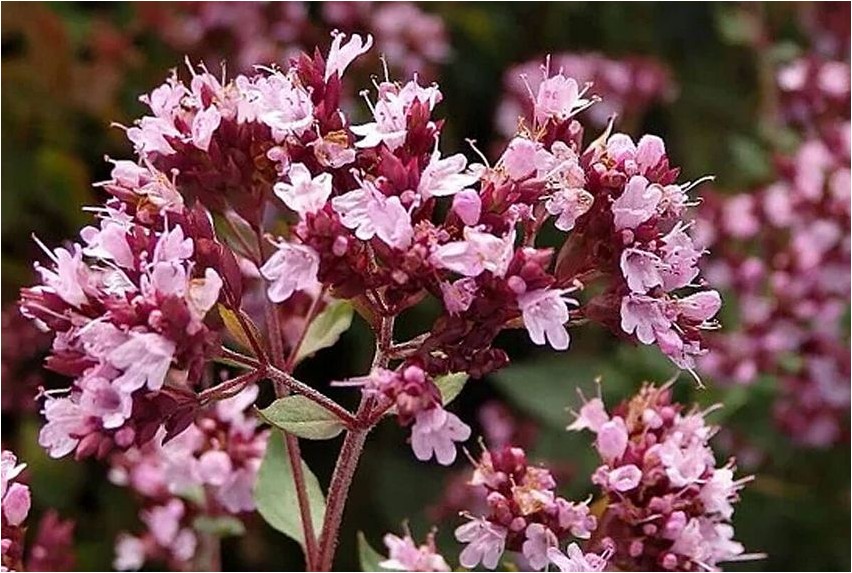
Oregano (lat. Origanum) is a perennial plant of the family Lamiaceae, or Lamiaceae. Its homeland is North America and Eurasia.
Another name for incense. Currently there are about 55 species.
Characteristics
Oregano is a herbaceous plant or subshrub 30-75 cm high with a bare, often creeping, strongly branched rhizome. The stem is erect, tetrahedral, glabrous in the upper part, pubescent in the lower part. The leaves are opposite, entire, oblong-ovate, pointed, the outer side is dark green, the inner side is green with a grayish coating, located on the petioles.
The flowers are small, tubular, pink or pink-purple in color, collected in corymbose or paniculate inflorescences. The bracts are red-violet, the corolla is two-lipped, pale violet with a pink tint. The fruit is an achene. Flowering occurs in July-August.
Growing conditions

Oregano is a light-loving plant that prefers open sunny areas. The soils for growing oregano are preferably loose, dry, with a rich mineral composition. The plants are resistant to drought and frost, generally unpretentious; with minimal care, you can achieve abundant flowering and a good harvest.
Reproduction and planting
Oregano is propagated by seeds and cuttings. The crop is grown mainly by seedlings. Seeds are sown in the first ten days of March in special seedling containers filled with moist substrate. The optimal growing temperature is 18-20C. If the maintenance conditions are met, seedlings appear in 1. 5-2 weeks. Seedlings grow very slowly, with two pairs of true leaves appearing on young plants; seedlings are planted in separate pots. This procedure is carried out very carefully so as not to damage the developing, not yet strong root system.
Transplantation of seedlings into open ground is carried out in mid-May, but the seedlings are first hardened in the fresh air. The site for growing the crop is prepared in the fall, the soil is carefully dug up, and mineral and organic fertilizers are applied. In the spring, the ridges are loosened, and shallow holes are formed on them. The seedlings are planted together with a clod of earth. The distance between plants should be about 15-20 cm. After planting, the ridges are watered abundantly and mulched with peat.
Some gardeners grow oregano by sowing seeds in open ground. This method is less effective. Sowing is carried out in early spring, the seeding depth is 0. 5-1 cm. With the emergence of seedlings, young plants are thinned out. They also carefully monitor soil moisture; this is very important when forming the root system.
Adult plants are propagated by dividing the bush. This procedure is carried out either in early spring or autumn. Oregano bushes are dug up, the roots are cleared of the soil, and they are divided so that there are at least one or two shoots on one section. The cuttings are planted in pre-prepared, well-watered holes, covered with soil and mulched with peat. Plants take root quite quickly.
Care
Oregano does not tolerate waterlogging, so it does not require regular watering. The plant does not tolerate stagnant water in the area. The crop responds well to fertilizing in the form of superphosphate and rotted humus, but applying fresh organic fertilizers is not recommended. To ensure abundant and long-lasting flowering, experts advise feeding the plants with ammonium nitrate or nitroammophos before budding. Systematically loosen and remove weeds between rows. Since oregano has a specific odor, it is rarely affected by pests and diseases, so the plant does not need preventive treatments.
Harvesting and storage
Oregano herb is collected at the beginning of mass flowering. Later dates are not desirable, since the content of essential oils in plants decreases, and, consequently, the quality of the raw materials. Cut off the tops of oregano at a height of 20-30 cm from the ground cover. Dry in well-ventilated and shaded areas, after which the grass is placed in opaque containers and covered with tight lids. Store oregano separately from other herbs. The shelf life of raw materials is 2 years.
Application
Oregano is a highly ornamental plant, often used in floriculture to decorate edgings and flower beds, as well as herb gardens. Low-growing forms are used in rock gardens. Oregano has become widespread in folk medicine; its medicinal properties have been known since ancient times. Oregano has an analgesic, tonic, antiseptic, expectorant, gastric, tonic and stimulating effect.
The herb is used in the perfume industry and in cooking. Oregano is rich in essential oils, ascorbic acid and tannins. Leaves and flower buds serve as both a seasoning and a medicinal raw material, both fresh and dried. Oregano has a pleasant aroma and taste, so it adds piquancy to dishes, moreover, it stimulates the appetite.
By the way, some types of this miraculous herb are added to alcoholic beverages. Oregano is also included in diaphoretic preparations, bath preparations and various tinctures used in the treatment of coughs, migraines, rheumatic pain and digestive disorders.





