Bunchosia argentea
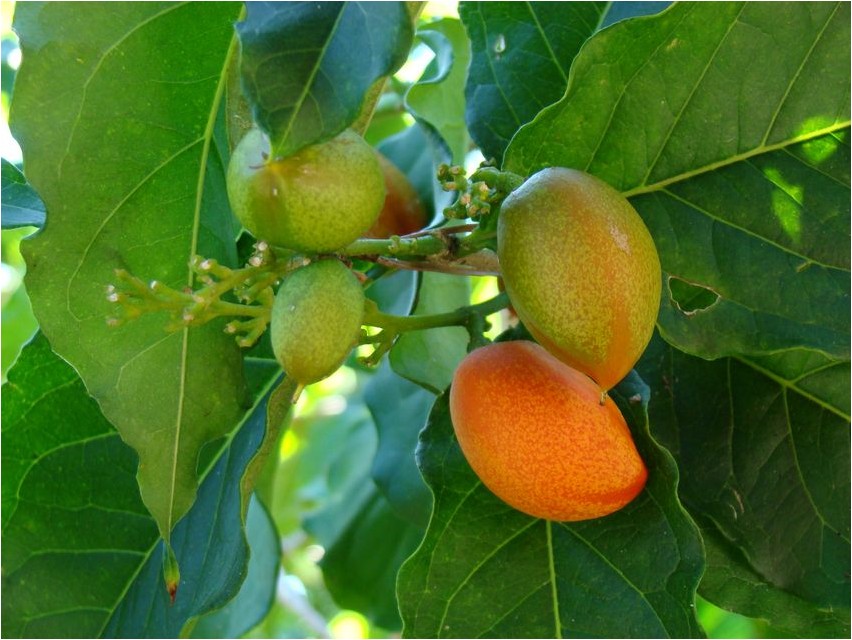
Bunchosia argentea (Latin: Bunchosia argentea) is a small fruit tree in the Malpighiaceae family, closely related to the Nance fruit tree and related to the Barbados cherry.
Description
Bunchosia argentea is a fairly compact tree, rarely exceeding ten meters in height. Although this tree is evergreen, it can easily lose its leaves during frosts, but the leaves will inevitably grow back as soon as the weather warms. On the undersides of the leaves, hairs can be seen tightly pressed against the leaf blades, allowing the epidermis to be completely concealed—hence the name “silver” Bunchosia. This plant blooms with incredibly spectacular bright yellow flowers.
Trees usually begin to bear fruit when they are two or three years old. And from the age of three or four, they can delight you with a harvest up to three times a year. The fruits of the silverleaf bunchosia form intricate clusters and are characterized by an elliptical shape. Each fruit is relatively short, typically between three and four centimeters long. The fruit”s color can be yellow, orange, or bright red. The pulp contained within each fruit, surrounding a fairly large pit, is very sticky, thick, and incredibly tasty, with a consistency somewhat similar to that of a fig. However, some people claim that the taste of silverleaf bunchosia fruits is very reminiscent of raw sweet potato.
The fruits of this amazing plant also boast a distinct peanut butter aroma—hence its nickname, the “peanut butter tree.” Where it grows
Bunchosia argentea was first discovered in Central and South America, where it still thrives today. It is also grown in South Florida and Colombia, as well as on the picturesque islands of the Caribbean and as far away as Venezuela.
Uses
Bunchosia argentea fruits can be eaten fresh or made into wonderful jam. They also make excellent jellies, preserves, and jams, and can be preserved and added to milkshakes. The buttery consistency of the aromatic flesh of this unusual fruit makes it easy to spread on slices of bread.
This plant also boasts extraordinary decorative properties — all thanks to its magnificent, showy flowers. Such valuable quality makes it possible to use silver bunhosia for landscaping gardens and parks. And in some countries it is grown with great pleasure as a houseplant.

Contraindications
There are currently no specific contraindications to consuming silvery bunchosia fruits, but the risk of allergic reactions cannot be completely excluded.
Growing and care
When growing silver bunchosia, there is absolutely no need to constantly maintain high temperatures — this feature allows you to grow this unusual tree even at an altitude of 4600 meters. However, during frosts, fruit trees may die.
Silver bunchosia requires sufficient light and well-moistened soils, since its growing season is very long. As for its reproduction, it occurs by seeds. Before you start growing silver bunchosia, you should carefully familiarize yourself with the technology of its cultivation, since this crop is considered to be quite capricious.
Peanut Butter Fruit Review (Bunchosia argentea) — Weird Fruit Explorer Ep 152





