Pallas’ primrose
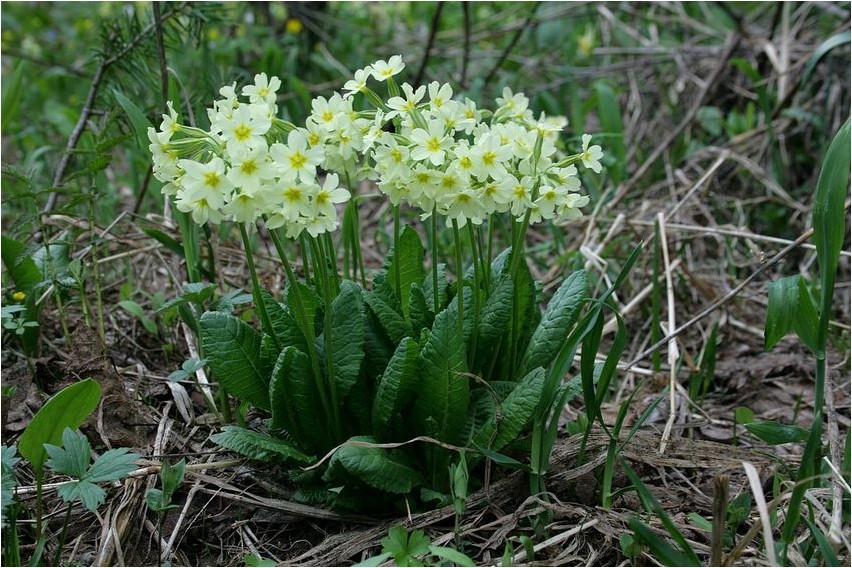
Pallas’s primrose is one of the plants of the family called primroses; in Latin the name of this plant will be as follows: Primula pallasii Lehm.
As for the name of the pallas primrose family itself, in Latin it will be: Primulaceae Vent.
Description of Pallas primrose
Pallas primrose is a perennial herbaceous plant whose height will vary between ten and thirty centimeters. The rhizome of this plant will be quite short, it is endowed with a large number of thick, cord-like adventitious roots. The leaves of the pallas primrose will be elliptical, their length will be about five to eighteen centimeters, while the width will be equal to two to seven centimeters, such leaves gradually taper into a winged petiole. The length of the arrows of the inflorescences of this plant is about ten to thirty centimeters, and the umbrella itself is 2-15-flowered. The corolla of the pallas primrose is painted in light yellow tones and has a flat bend, and its diameter can reach two centimeters. The capsule of the pallas primrose is oblong-ovoid in shape.
This plant blooms in June. Under natural conditions, this plant is found in the Caucasus, the Altai region of Western Siberia, the Volga-Kama region of the European part of Russia, Central Asia and the Angara-Sayan region of Eastern Siberia. For growth, pallas primrose prefers alpine lawns, the upper border of the forest and places near melting snow. It should be noted that this plant is not only a honey plant, but will also be very decorative.
Description of the medicinal properties of pallas primrose
Pallas primrose is endowed with very valuable healing properties, and it is recommended to use the roots and rhizomes of this plant for medicinal purposes. The presence of such valuable healing properties is recommended to be explained by the content of vitamin C, flavonoids and triterpene glycosides in this plant.
An infusion prepared from the roots and rhizomes of this plant is recommended for use as an expectorant, diaphoretic and anti-inflammatory agent for nephritis, tuberculosis, pneumonia, bronchitis, scurvy, rheumatism, cystitis and asthenic conditions. Pallas primrose leaves are also used in the form of tea: this healing agent is indicated for use in cases of vitamin deficiencies, while an infusion based on the flowers of this plant is used as a diaphoretic.

For jade, it is recommended to use the following very healing remedy based on this plant: to prepare such a healing remedy, you will need to take one teaspoon of crushed pallas primrose roots per glass of water. It is recommended to boil the resulting healing mixture for about seven to eight minutes, and then it is strongly recommended to strain this mixture very carefully. Take the resulting healing remedy based on pallas primrose three to four times a day, one tablespoon.
For cystitis, you should use the following very effective healing remedy based on this plant: to prepare such a medicine, it is recommended to take one tablespoon of crushed dry leaves per glass of boiling water. It is recommended to infuse the resulting mixture based on pallas primrose for about two hours, after which this mixture should be filtered very carefully. Take this healing remedy four to six times a day, one or two tablespoons. It is important to note that when used correctly, such a healing remedy is very effective.
Spring primrose: beneficial properties and applications
https://www. youtube. com/watch? v=x-N2-_etp7k





