Creeping tenacious
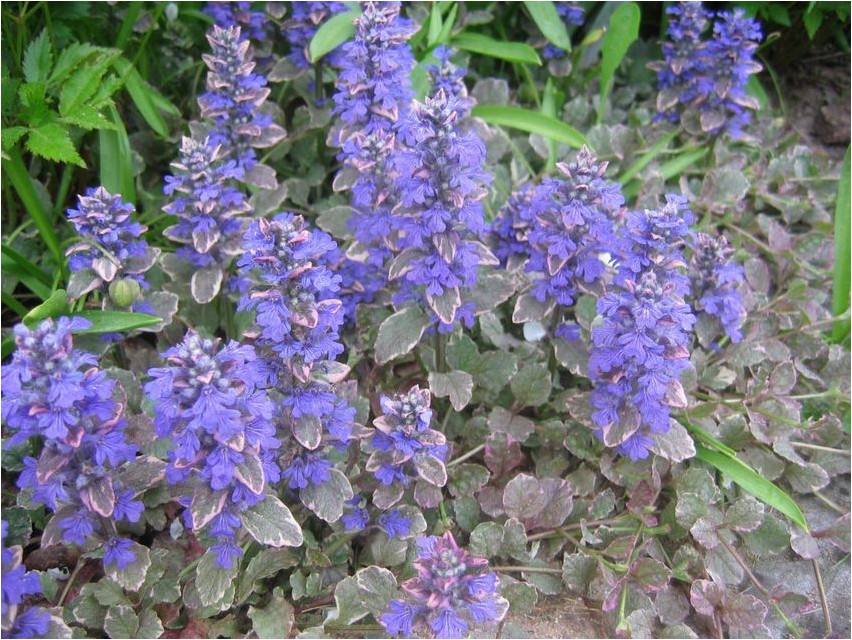
The creeping tenacious is one of the plants of the family called Lamiaceae; in Latin the name of this plant will be as follows: Ajuga reptans L.
As for the name of the creeping tenacious family itself, in Latin it will be like this: Lamiaceae Lindl.
Description of creeping tenacious
Creeping tenacious is a perennial herbaceous plant, endowed with a shaggy straight tetrahedral stem, as well as rather long rooting shoots, the height of which will be about ten to thirty-four centimeters. The leaves of this plant can be oblong, obovate or oval. The basal leaves are larger and longer-petioled, they are equipped with spaced teeth. The stem leaves will be sessile and notched-toothed, while the bracts will mostly be entire and entire, with bluish tones at the base. The flowers of the creeping tenacious will be one-lipped, they are colored either blue or blue, sometimes such flowers can be pink or white. Such flowers are collected in false whorls of six to eight pieces. Such whorls form a more or less dense inflorescence at the end of the stem, which will be spike-shaped. The fruit of this plant will consist of four slightly hairy nuts, they will be wrinkled and located at the very bottom of the calyx.
Flowering of creeping tenacious occurs during the period from May to June. Under natural conditions, this plant can be found in the European part of Russia, as well as in the Caucasus and Ukraine. For growth, the plant prefers shrubs, fields, meadows, edges and forest clearings.
Description of the medicinal properties of creeping tenacious
Creeping tenacious is endowed with very valuable healing properties, and it is recommended to use the grass and leaves of this plant for medicinal purposes. The term grass includes flowers, stems and leaves. The raw materials of this plant should be harvested from May to June.
It should be noted that the chemical composition of this plant has not yet been fully studied. It is reliably known that the composition of creeping tenacious contains alkaloids. The plant is endowed with diuretic, anti-inflammatory, diaphoretic, wound-healing, astringent and metabolism-improving effects.

As for traditional medicine, it is recommended to use an infusion of the herb of this plant to treat malaria: take one tablespoon per glass of boiling water to prepare such a remedy. It should be noted that such a remedy was widely used during the Crimean War. Also in folk medicine, the properties of this plant are used for gastritis, diarrhea, cholelithiasis, stomach and duodenal ulcers, pulmonary tuberculosis, rheumatism, hemoptysis and inflammation of the female genital organs, and also as a diaphoretic for various colds.
Externally, an infusion of the creeping herb is used in the form of lotions and washes for ulcers, burns and wounds. In the form of rinses, the infusion of the herb is used for inflammatory processes and ulcerations of the oral mucosa, as well as for gingivitis and sore throats. The juice of the herb of this plant is used to lubricate calluses and freckles, as well as rashes from bee stings, thrush in children and burns.
Crushed fresh leaves can be applied to cuts, ulcers and purulent wounds. It is recommended to wash your hair with an infusion made from herbs or leaves to enhance hair growth.
For stomatitis, you should use the following remedy: to prepare it, take two teaspoons of the herb, and then infuse them for two hours in one glass of boiling water, after which the mixture is carefully filtered. Take this remedy one tablespoon three times a day.





