Sumac
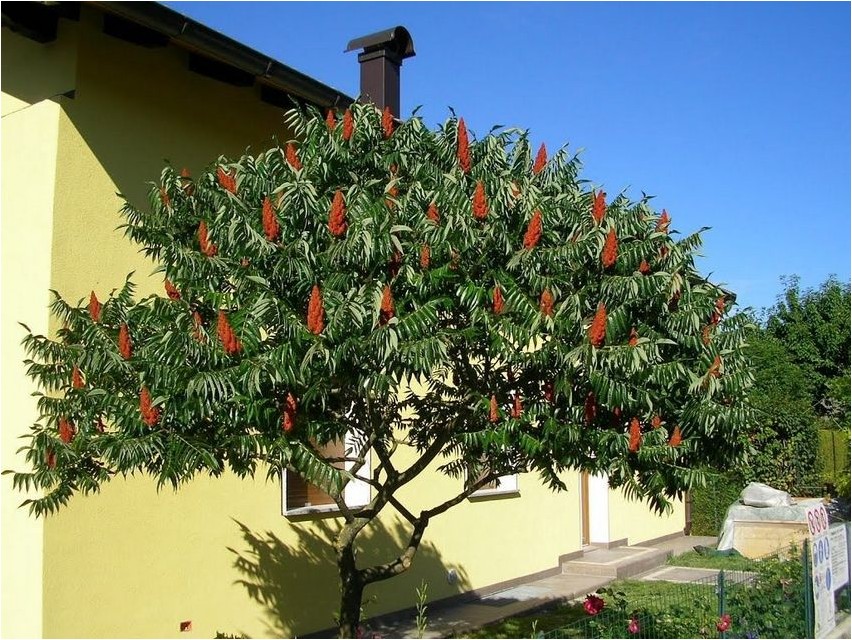
Sumac (Latin: Rhus) is a genus of shrubs or small trees in the sumac family (Anacardiaceae). It is also known as the vinegar tree.
The genus comprises approximately 250 species. It is native to the temperate and subtropical zones of North America, Asia, and Europe. Some species are distinguished by their highly allergenic foliage and gray-white fruits.
Cultural Characteristics
Sumac is a deciduous, or rarely evergreen, shrub or tree growing 10-12 meters tall. The shoots are light brown, horizontal, and pubescent over the entire surface. The leaves are dark green, compound, trifoliate, pinnate, textured, and velvety, borne on winged or rounded petioles. In autumn, the leaves change color to fiery orange, scarlet, and purple hues. The flowers are small, inconspicuous, greenish or orange-yellow in color, with a distinctive scent, gathered in paniculate, spike-shaped, or terminal inflorescences. The fruits are small, dark red, with a hairy surface, gathered in vertical racemes. Sumac is a fast-growing plant with the ability to form suckers. The growing season lasts from late April to late October (depending on climate).
Growing Conditions
Sumac is drought-resistant and sun-loving, preferring well-lit areas protected from cold winds. It is undemanding regarding soil conditions, tolerating some salinity without problem. Sumac grows best in moderately moist, fertile, and well-drained soils.

Propagation and Planting
Sumac is propagated by seeds and root suckers. The latter method is more effective; the only drawback is that the plants form a large number of root suckers. Before sowing, seeds are stratified for two months; when sown in the fall, they undergo natural stratification. They also require treatment with sulfuric acid and subsequent rinsing in boiling water. Sumac seedlings grow very quickly, with careful care, of course. Young plants should be spaced well apart.
Care
Caring for sumac does not cause any particular difficulties. It is necessary to regularly loosen and clear the tree trunk area from weeds. It is important to do this very carefully, since even minor damage to the roots leads to the formation of abundant growth. It is advisable to mulch the tree trunk area with sawdust in a layer of 5-8 cm. Young plants need watering only during a long drought, adults can do without it. The crop is fed once a year in early spring with nitroammophos at the rate of 30 g per square meter. Sanitary pruning is carried out in the spring. In the winter, the tree trunk circles are mulched with a thick layer of humus or peat; in the spring, the cover is removed.
Application
Sumac is an ornamental plant that gives the impression of an exotic palm tree. And in fact, from a distance the plants resemble multi-stemmed palm trees. The crop is used in landscaping parks and gardens and looks great in single and group plantings. It is often used to decorate rocky hills and strengthen soils that are susceptible to water and wind erosion. The beautiful color of the foliage in autumn allows the plant to be used in seasonal compositions, for example, in autonalia.
Sumac looks especially good against the backdrop of dark coniferous plantings. With the help of a plant, you can create magnificent expressive compositions that will add zest to the appearance of the garden. In winter, the plants are also decorative thanks to their bright clusters of red fruits. Some types of sumac, in particular tannic sumac, are used as a spice. The plant has become widespread in folk medicine. The poisonous sumac species has quite dangerous properties; if it comes into contact with parts of the plant, you can get a severe burn.
Staghorn sumac or vinegar tree