Euphorbia steppe
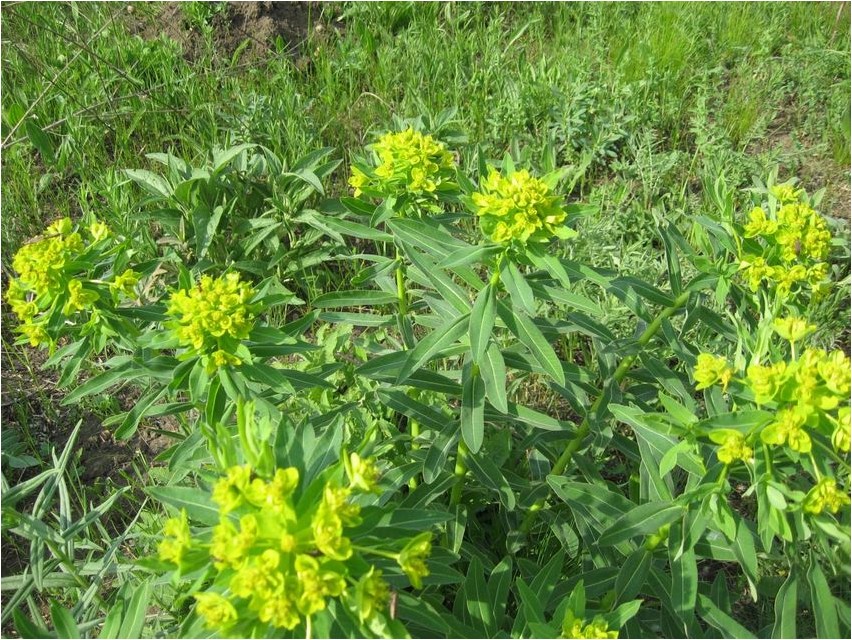
Steppe spurge is one of the plants of the family called Euphorbiaceae; in Latin the name of this plant will be as follows: Euphorbia stepposa Zoz.
As for the name of the steppe milkweed family itself, in Latin it will be: Euphorbiaceae Juss.
Description of milkweed steppe
Euphorbia steppe is a perennial herbaceous plant, the height of which will fluctuate between twenty and seventy centimeters. Such a plant is almost naked, and its color will be grayish-green. The root of this plant is multi-headed and thick. The stems of steppe milkweed will be numerous, at the top they will be endowed with three to fourteen peduncles, the length of which will be about one and a half to eight centimeters. The involucre leaves of this plant are lanceolate-elliptical, their length can reach approximately five centimeters, and the width will be equal to five to ten millimeters. The involucre leaves will have only one vein, and sometimes they may be slightly yellowish in color. The cup of steppe milkweed is cube-shaped, its length will be about two to two and a half millimeters, and the width will be equal to one and a half to two millimeters; such a cup is naked. The nectaries of this plant will be hornless and trapezoidal. The three-nut of steppe milkweed is ovoid, its length is three to four millimeters, and its width is about two and a half to three and a half millimeters. This three-nut is smooth and vaguely grooved. The seed of this plant will be compressed-oblong, smooth and grayish-green in color, its length will be about two millimeters, and its width will not exceed one and a half millimeters.
The flowering of steppe milkweed occurs in June, while fruiting will occur in July. Under natural conditions, this plant is found in the north of Crimea, Ukraine, the Caucasus, Moldova and the European part of Russia.
Description of the medicinal properties of steppe milkweed
Steppe spurge is endowed with very valuable healing properties, and it is recommended to use the herb of this plant for medicinal purposes. The term grass includes the leaves, flowers and stems of milkweed prairie.
The presence of such valuable healing properties should be explained by the content of flavonoids, catechins and phenol carbonic gallic acid in this plant. Milkweed steppe is endowed with laxative, diuretic, antispasmodic, and anthelmintic effects. An infusion prepared from the herb of this plant is recommended for use as a diuretic, and a decoction is used externally to treat eczema. An aqueous extract of milkweed is used externally to remove warts and treat malignant tumors.

The milky juice of milkweed is used to remove calluses and warts. It is noteworthy that this plant is poisonous, for this reason it is recommended to exercise extreme caution when handling this plant. It is important to remember that when using large doses of drugs based on this plant, serious complications can occur, which should include, in particular, inflammation of the gastrointestinal tract. It is also important to remember that the milky juice of steppe milkweed will severely affect the skin, mucous membranes of the nose and eyes.
The following remedy is used as a diuretic: two grams of dry crushed herbs per one glass of boiling water. The resulting mixture should be infused for about two hours, after which this mixture is carefully filtered. Take this remedy two to three times a day, one tablespoon.





