Maple
Maple (lat. Acer) is a genus of shrubs and trees of the Sapindaceae family. Previously, the genus was classified as a member of the Maple family. In nature, maple is found in North America, Asia and Europe.
Most species are distributed in temperate latitudes, and only one species, the laurel maple (lat. Acer laurinum), grows in countries with hot climates. In Australia and South America, maple is completely absent. About 20 species are widespread in Russia, in particular White Maple, or pseudosycamore, Norway Maple, Field Maple, Tatarian Maple, Small-Leaf Maple, Riverside Maple, Manchurian Maple.
Characteristics of culture
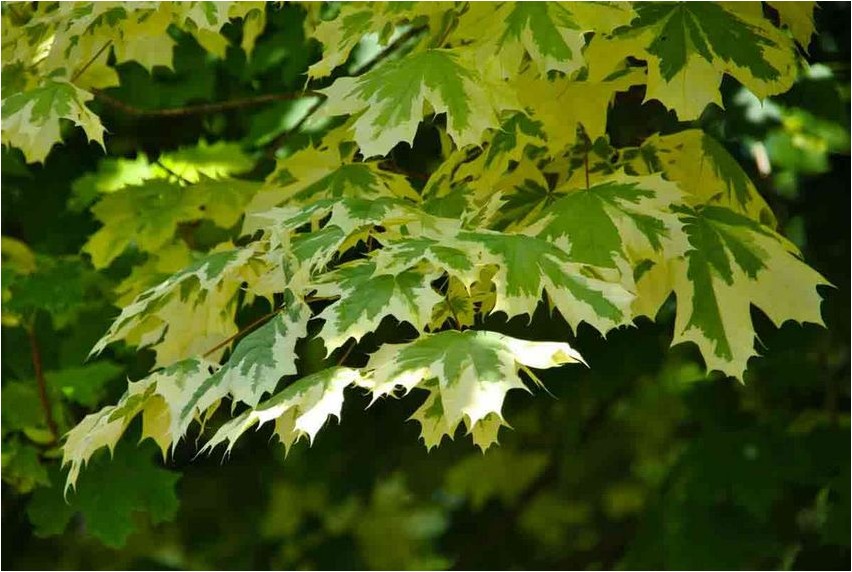
Maple is a deciduous or evergreen shrub or tree from 5 to 30-40 m in height with gray-brown bark, which becomes darker and cracks with age. The branches are quite strong and directed upwards. The leaves are green, simple, palmate, glabrous or pubescent, pointed or obtuse, equipped with 3-9 veins. In some species the leaves are compound pinnate or compound palmate. In autumn, the foliage becomes yellowish or orange in color; only a small part of the representatives of the genus are green all year round.
The flowers are orange, yellow, green, yellowish-green or red, fragrant or odorless, five-petaled, collected in corymbose, umbellate or racemose inflorescences. Maples bloom in early spring, less often at the end of winter, usually when the leaves bloom, sometimes earlier. The fruit is a lionfish, formed 2-6 weeks after flowering. During ripening, the fruit splits into two fruitlets containing one seed each. Seeds flattened, bare.
Growing conditions
Almost all representatives of the genus are shade-tolerant, but they develop and bloom better in intensely lit areas. Each species of the genus has its own requirements for soil conditions, for example, Norway maple prefers fertile, moderately moist and acidic soils; Bearded maple — any garden soil without compaction; Fan maple — loamy or sandy, fertile, slightly acidic soils; Red maple — moist soils; Tatarian maple is unpretentious, tolerates even saline soils; Field maple — fertile, not too acidic substrates.
Reproduction and planting
Maple propagates by seeds and vegetatively (cuttings, layering and grafting). Seeds are subjected to long-term stratification before sowing. Cuttings are also acceptable, but the rooting percentage does not give high results. Cuttings are taken in the fall and planted in the spring. This method is recommended to be used only if it is not possible to obtain seeds. Maple seeds are sown in the fall under cover; in this case, the seeds do not need stratification, since they undergo it under natural conditions. Entrances appear as the weather warms up.

Most representatives of the genus produce a large number of root suckers during growth; they are also suitable for propagating the crop. When propagating maple by air layering: select the lower healthy shoot, make cuts on it using a clean knife, treat it with root formation stimulants and wrap it in damp sphagnum moss and then in plastic wrap. Over time, strong roots form in the places of the cuts, but the cuttings are separated only next spring. This method is most suitable for warm climates. In cold regions, cuttings are laid in soil furrows.
Care
Maple is moisture-loving and needs regular and abundant watering. It is undesirable to allow waterlogging. During drought, the amount of watering is doubled. Optimally 15 liters per plant per week. After watering and removing weeds, the stem zone is loosened; this is necessary in order to avoid soil compaction, which negatively affects the development of most maples.
The crop does not require formative pruning, but sanitary pruning should not be abandoned. Representatives of the genus also do not need shelter for the winter, but in regions with a cold climate, young plants are covered with spruce branches, and the stem zone is mulched with peat or dry fallen leaves. Maples are resistant to diseases and pests and are rarely affected by coral spot, powdery mildew, brown rot, etc.
Application
Maples are widely used in garden design. They look great in group and solitary plantings. Dwarf forms fit harmoniously into rocky gardens — rockeries and rock gardens. Some species are appropriate in Japanese gardens. Ginalla Maple, Tatarian Maple and Field Maple are often used to create hedges and protective plantings against the wind.