Consolida eastern
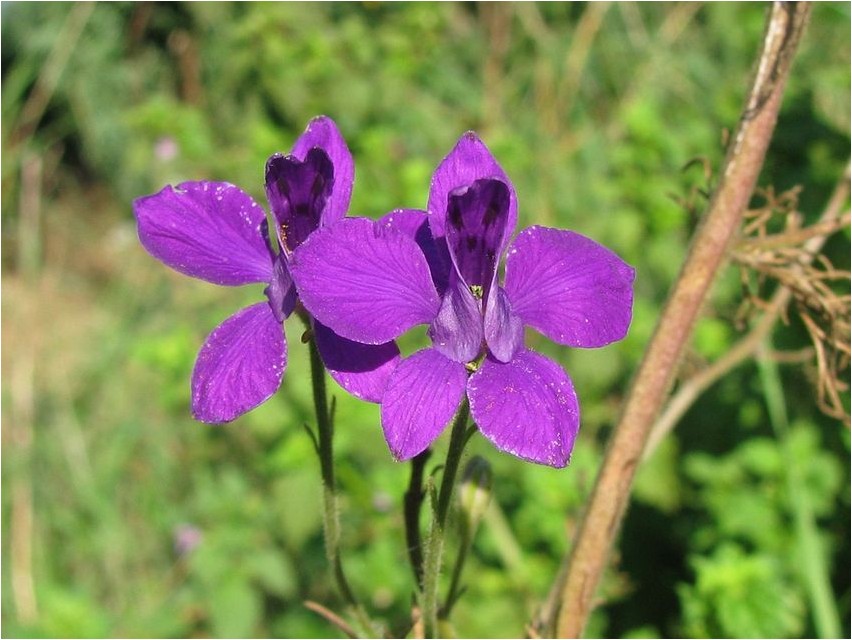
Consolida orientalis is one of the plants of the family called Ranunculaceae; in Latin the name of this plant will be as follows: Consolida orientalis (J. Gay) Schriding.
As for the name of the consolid eastern family itself, in Latin it will be: Ranunculaceae Juss.
Description of the eastern consolidation
Consolida eastern is an annual herbaceous plant, the height of which will be eighty centimeters. Most often, the stem of this plant will be branched, but in the upper part it will be glandular and pubescent. The leaves of consolid eastern are usually three-triple dissected. The raceme of flowers of this plant is long and quite dense, its color will be bright purple-violet, the peduncles will be spaced and short, their length will be approximately eight to twenty millimeters. The spur of the consolid eastern will be densely and short-haired; it can be either slightly curved or straight. The spur is quite short and its length is eight to nine millimeters, the length of the leaflet will not exceed one and a half to three centimeters. Such a leaflet of this plant will be more or less densely pubescent, and at the top it turns into the shortest spout, the length of which will be a centimeter to one and a half centimeters. The seeds of this plant are colored black and purple.
Flowering of consolid eastern occurs in the period from May to June. Under natural conditions, this plant is found in the Crimea, the Caucasus, Central Asia and the Carpathians. It is noteworthy that consolida orientalis is both a honey plant and an ornamental plant.
Description of the medicinal properties of Consolidum eastern
Consolidum eastern is endowed with very valuable healing properties, and it is recommended to use the flowers of this plant for medicinal purposes.
The presence of such valuable healing properties should be explained by the content of alkaloids in the composition of this plant, and fatty oil will be present in the seeds. It should be noted that consolidum orientalis is endowed with quite valuable antibacterial effects. An infusion prepared from the flowers of this plant is recommended for use as a diuretic and anthelmintic.

The plant can dye silk in blue and purple tones, while consolidum orientalis will dye wool and cotton fabrics in yellow-green and yellow tones.
The following rather effective remedy, based on Consolida orientalis, can be used as a diuretic. To prepare this remedy, take one teaspoon of this plant’s flowers per cup of boiling water. Let the mixture steep for one hour, then strain thoroughly. Take this remedy, one tablespoon at a time, three to four times daily. It’s important to note that to achieve maximum effectiveness, it’s important not only to strictly adhere to all the instructions for taking this remedy, but also to carefully follow all the directions for use.
To regulate the menstrual cycle, the following rather effective remedy, based on Consolida orientalis, is recommended: to prepare this remedy, take one tablespoon of this plant’s flowers per liter of boiling water. Let the mixture steep and then use it for approximately five to seven days, one glass two to three times daily. It should be noted that this remedy, when taken correctly, is very effective, and the positive effect will be noticeable quite quickly, most often after the first three days of use.





