Toothed oak
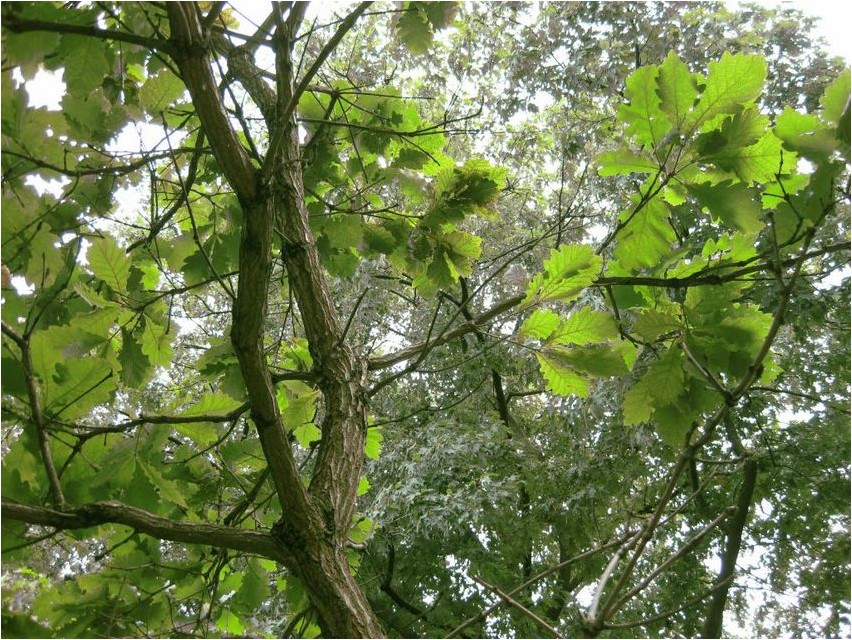
Toothed oak is one of the plants of the family called beech, in Latin the name of this plant will be as follows: Quercus dentata Thunb.
As for the name of the dentate oak family itself, in Latin it will be: Fagaceae Dumort.
Description of jagged oak
The serrated oak is a tree whose height will range from fifteen to twenty meters, and its diameter will be approximately eighty centimeters. Most often, the height of the tree will be six to eight meters, and the diameter will be thirty to forty centimeters. The bark is dark gray in color and is thick and cracking.
The young shoots of this plant are densely shaggy, and the pubescence will disappear only in the second year. Almost serrated oaks are large, their length is up to one centimeter, they are densely pubescent. The leaves will be large, their length is ten to twenty centimeters, and their width is about ten to twelve centimeters. In coppice shoots, the length of the leaves can reach fifty centimeters, and the width will be twenty to thirty centimeters. Above, the leaves are dark green in color, while below they are endowed with thick reddish pubescence, consisting of star-shaped hairs. The leaf blades will be short and wide, the plus is endowed with long, loose, narrow-lanceolate scales that are turned back. The length of hemispherical acorns is about two centimeters.
Under natural conditions, serrated oak is found in the Far East: in the south of Primorye, Kunashir Island, in the Southern Kuril Islands and in the south of Primorye. As for the general distribution, this plant is found in Korea and Japan. The plant will grow in small groves among oak trees, and can also form groves near the seashore or on dry slopes.
It is noteworthy that the serrated oak is a very ornamental plant. It is cultivated in Batumi and Sukhumi. This species will be quite rare, and its reserves are small. The plant is protected, and it is also planned to develop new methods of its propagation.

Description of the medicinal properties of serrated oak
Serrated oak is endowed with very valuable healing properties, and it is recommended to use the leaves, acorns and bark of this plant for medicinal purposes. As for traditional medicine, bark, leaves and acorns are used as astringents.
The wood of this plant is used in shipbuilding, carpentry and plywood production. However, due to insignificant reserves, the plant is not endowed with industrial significance.
For diarrhea, frequent urge to urinate, hemorrhoidal bleeding, gastric ulcers and chronic enterocolitis, it is recommended to use the following remedy: to prepare it you need to take ten grams of crushed serrated oak bark per glass of boiling water. The resulting mixture should be infused for two hours. Take two tablespoons three to four times a day.
To rinse the mouth for stomatitis, laryngitis, gingivitis, and also for lotions and washing wounds, it is recommended to use the following remedy: to prepare it, take one tablespoon of crushed bark of this plant per glass of boiling water. The resulting mixture should be infused for three to four hours, and then this mixture should be carefully filtered.
For frequent urination, diarrhea and enterocolitis, it is recommended to use the following remedy: to prepare it, take one tablespoon of crushed serrated oak leaves per glass of boiling water, and then infuse and filter. This remedy is taken one to two tablespoons per day.