Paulownia
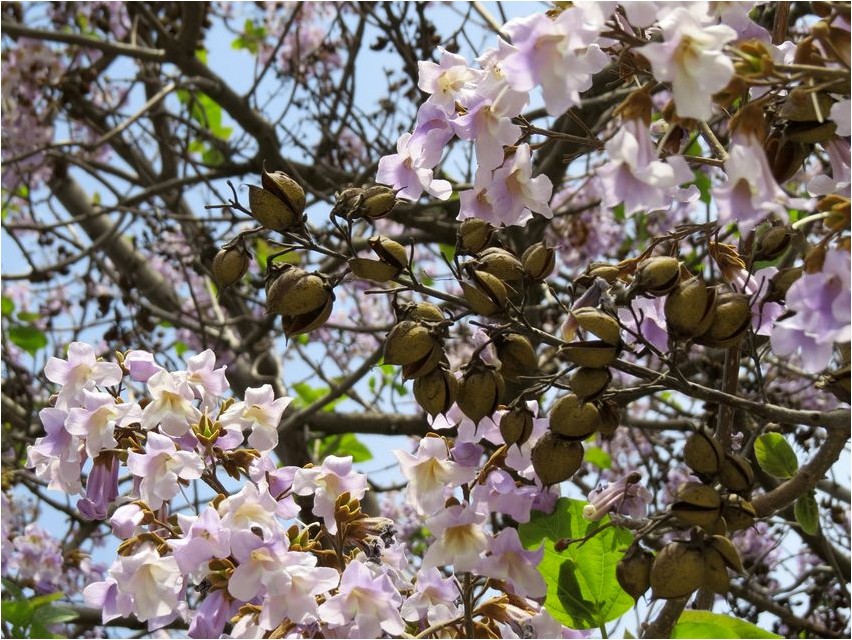
Paulownia, or Adam”s tree (lat. Paulownia) is a genus of trees of the Paulownia family. Previously, the genus was classified as a member of the Norichniaceae and Bignonieceae families.
The culture received its name in honor of the daughter of Emperor Paul I, Anna Pavlovna. The genus includes 10 species, according to other sources — 17 species.
Distribution
Paulownia grows wild in Southeast Asia, more precisely in China, Taiwan, Laos and Vietnam. Some species are found in the Far East, the Caucasus, Crimea and the southern and western regions of Ukraine. In European countries, as well as in North America, Paulownia tomentosa (lat. Paulownia tomentosa) is widely cultivated.
Characteristics of culture
Paulownia is a tall deciduous or semi-evergreen tree with an ovoid or round spreading crown and a straight cylindrical trunk. The leaves are entire, large, wide, heart-shaped or ovate, up to 20 cm long, have no stipules, sit opposite on long petioles. The leaves are pubescent on the outside and felt-like on the inside.
The flowers are medium-sized, pale purple or violet-lilac, less often white, collected in panicles. The calyx is bell-shaped. The fruit is a broadly ovoid capsule. The seeds are small, winged. The first fruits of the plant form 4-5 years after planting. Paulownia is characterized by rapid growth and is often used to reclaim areas threatened by erosion or areas damaged by fires. The crop is also suitable for landscaping parks and gardens.
Growing conditions
Paulownia develops best in open sunny areas with no lateral shading. Paulownia should not be planted in close proximity to other large trees, as its root system can suppress other crops. Ideal for paulownia are southwestern slopes, protected from northern winds, with stable snow cover in the winter.

The crop is not picky about soil conditions. On sandy soils, plants produce small growths, but the wood ripens several times better than on other soils. On clay soils, wood ripens very slowly, often the plants freeze completely, than on light and aerated soils.
Reproduction and planting
Paulownia is propagated by seeds, cuttings and root suckers. The seeds lose their viability very quickly, so they are sown immediately after collection. Experienced gardeners advise propagating the crop by cuttings. They adapt and take root easily, requiring only increased soil moisture. It is best to plant paulownia in the fall, although spring planting is not prohibited. Seedlings and other planting material can be stored in a cool, dark room in winter.
Planting holes are prepared in 2-3 weeks, its depth should be 70-80 cm and width 60 cm. A certain amount of soil mixed with combined fertilizers and peat is poured into the bottom of the hole, forming a kind of roller or slide. After planting, the soil in the tree trunk area is thoroughly compacted, watered and mulched with dry healthy foliage or peat. Paulownia has a positive attitude towards transplanting, but it is advisable to carry out such a procedure from July to August. Before planting, the soil is cultivated to the depth of a spade.
Care
Despite the fact that paulownia is a drought-resistant plant, it needs systematic watering, especially during prolonged drought. With insufficient moisture, the leaves lose turgor and droop. If the weather is too hot, the edges of the leaves dry out, but are restored with the onset of rain.
As you know, paulownia can grow on poor soils without any problems, but it will not refuse to apply fertilizers. In the spring, organic matter, for example, humus, is added to the crop, and in mid-summer — mineral fertilizers. Paulownia accepts shaping and sanitary pruning, which consists of removing diseased, frozen, broken branches and normalizing the number of stems. The crop is resistant to pests and diseases and is rarely affected by slugs, which most often appear in wet weather.





