strawberry tree
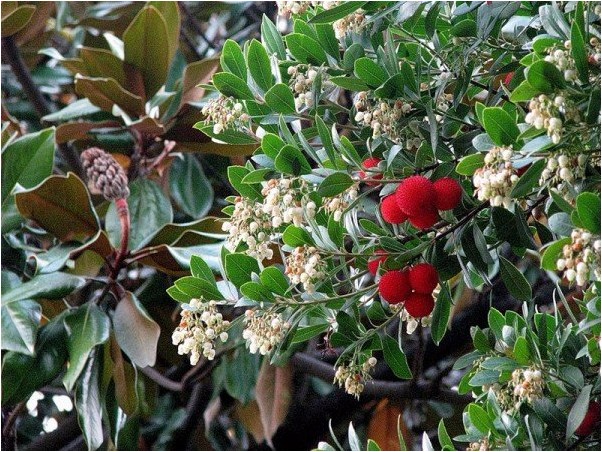
Strawberry tree (lat. Arbutus) is a genus of shrubs and trees of the Heather family. Other names: Arbutus, Strawberry. Most of the species are distributed in Mexico, as well as in North America, the Mediterranean and some European countries. The strawberry tree is also found in Crimea.
Characteristics of culture
Strawberry is an evergreen, slow-growing shrub or low tree with brown fissured or coral-red smooth bark and a wide-rounded openwork crown. The leaves are dark green, elliptical, leathery, serrate or entire, alternate, mounted on petioles.
The flowers are small, yellow or white, collected in erect paniculate or terminal pendulous panicles. The calyx is five-lobed and remains attached to the fruit. The corolla is fused-petalled, spherical-lily-shaped, can be white or pink in color, and is equipped with five blunt teeth wrapped outward.
The fruit is a multi-seeded, five-locular berry, covered with tuberous glands, orange or orange-brown, depending on the variety. The seeds are quite small, ellipsoidal. Strawberries bloom in May, the fruits ripen in mid-autumn, which largely depends on climatic conditions. The flower buds of the crop develop very slowly, usually taking several months — from May to October.
Growing conditions

Strawberry is a heat-loving plant; it prefers areas that are intensely lit and protected from northern winds. Some species tolerate light frosts, but immature shoots, as a rule, freeze and die.
The strawberry tree is unpretentious to soil conditions, but develops best in light, well-drained and fertile soils with a neutral pH reaction. The small-fruited strawberry species tolerates poor, calcareous and dry soils, but in this case one should not expect a good harvest.
Reproduction and planting
Strawberries are propagated mainly by seed, less often by cuttings. The seeds do not lose their viability for a considerable time; they are easily stored at room temperature. Before sowing, the seeds need preliminary stratification, which lasts two months. Sow the seeds in a mixture consisting of garden soil, peat and coarse sand. When three true leaves appear on the seedlings, they are planted in separate pots with a substrate of the same composition.
If necessary, re-picking is carried out using the transshipment method. Young plants are transplanted into open ground only after 2 years. It is extremely rare that strawberries are propagated by cuttings, and this is due to the fact that the cuttings, even when treated with growth stimulants, take root poorly. Semi-lignified cuttings 10-12 cm long are cut in July. Then they are planted in the soil mixture and kept in a room with a temperature of 16-18C. With the appearance of roots, the cuttings are transplanted into open ground.
Care
Fertilizing with mineral and organic fertilizers is important for strawberries. With the onset of spring, the crop is fed with rotted manure, and after a couple of weeks potassium and nitrogen fertilizers are applied. Such procedures will stimulate plant growth. In the future, fertilizing is carried out once every three months. Water the strawberry tree once every two weeks at the rate of 20 liters per bush. The crop also needs sanitary pruning, which involves removing frostbitten and broken branches. Strawberries do not require formative pruning. In winter, the soil in the tree trunk zone is mulched with a thick layer of peat or humus.
STRAWBERRY TREE
https://www. youtube. com/watch? v=gI1q023qWls