Pellionia pulchra
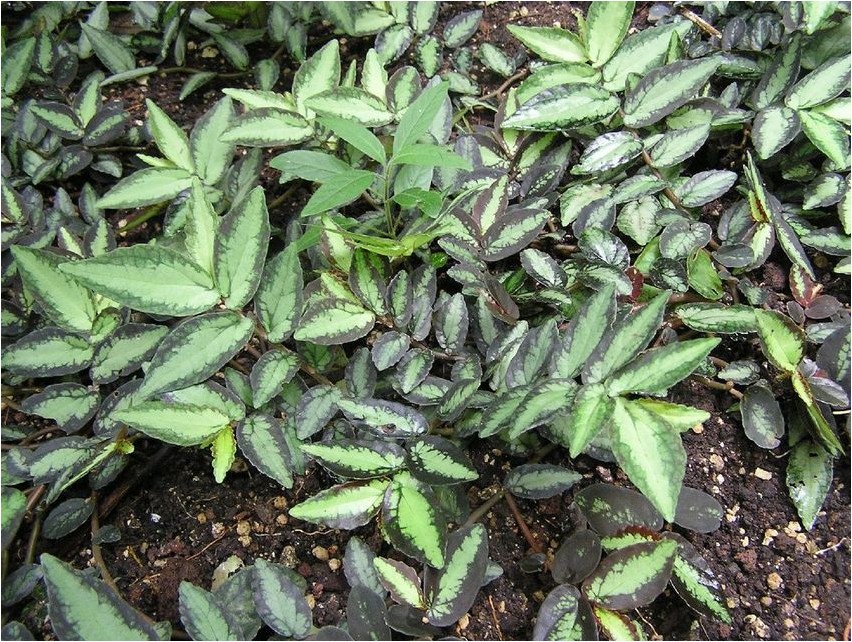
Pellionia pulchra is a member of the Urticaceae family of plants. Its Latin name is Pellionia pulchra.
The family name itself is Urticaceae.
Description of Pellionia pulchra
For optimal growth, this plant requires either full sun or partial shade. Water it generously throughout the summer, maintaining moderate humidity. Pellionia pulchra is an herbaceous plant.
This plant is recommended for landscaping rocky areas in both conservatories and greenhouses. Pellionia pulchra is grown as a groundcover. It is also used to form turf in terrariums. When growing the plant indoors, it’s recommended to create a mini-greenhouse, but it’s also sometimes used as a trailing plant in hanging baskets and planters.
As for its maximum size in cultivation, Pellionia glabra can reach up to sixty centimeters.
Description of Pellionia glabra care and cultivation
To ensure optimal development, this plant requires regular repotting. It’s worth noting that the plant has a shallow root system, so shallow but wide pots are preferred. However, when grown in greenhouses and conservatories, repotting is not necessary. The soil mixture itself should be a mixture of one part turf and sand, and three parts leaf mold. The acidity of this soil can be either neutral or slightly acidic. If the plant receives insufficient light, the leaves will noticeably fade, and the shoots themselves may become elongated. Leaves will turn yellow, rot, and dry out if the soil is insufficiently or excessively moist. In some cases, this plant may be damaged by whiteflies or aphids.

Throughout the rest period, the temperature should be maintained between fifteen and twenty degrees Celsius. Watering Pellionia beautiful requires moderate watering, and air humidity should be kept at a standard level. This dormant period is forced when the plant grows indoors. This period begins in October and continues until February. The reason for the occurrence of such a period lies in the insufficient degree of illumination, as well as in the low degree of air humidity.
Reproduction of Pellionia beautiful most often occurs through rooting stem cuttings, and the soil temperature should be about twenty to twenty-five degrees Celsius. The plant can also be propagated by dividing the bush, as well as using seeds.
The specific requirements of this crop include the fact that air humidity should always be maintained at a level below fifty percent. It should also be remembered that it is important to keep the variegated forms of this plant in bright, but diffused light.
The leaves of Pellionia splendor are endowed with decorative properties. The leaves are alternate; their shape can be either oblong or round. The length of such leaves is about two to six centimeters. The color of such leaves on top is black-green, and on the bottom the leaves will be pale red, while along the veins the leaves are colored in light green tones.
Peperomia or Pellionia? And the answer to the question how many flowers do I have?