Karanda
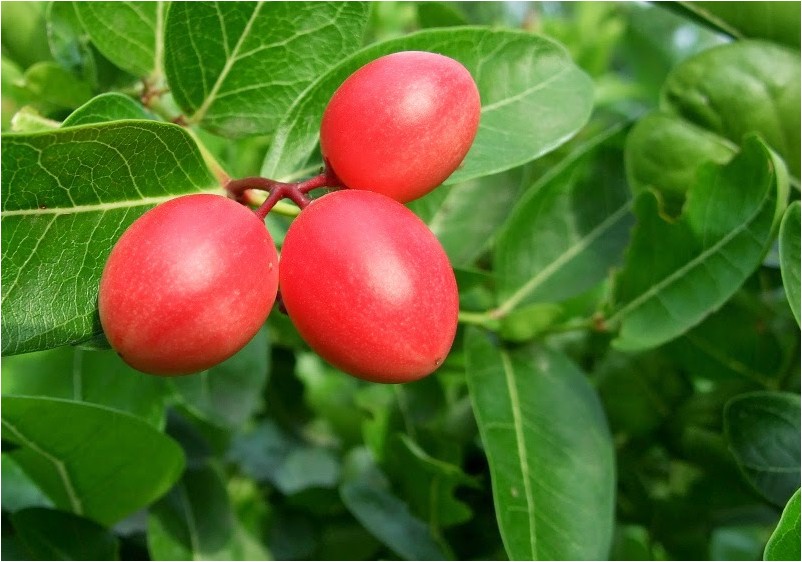
Karanda (lat. Carissa congesta, Carissa carandas) is a fruit plant from the Kutrovaceae family.
Description
Karanda is an extremely attractive evergreen shrub plant, the height of which most often ranges from three to five meters. Each shrub boasts an incredibly dense crown and fairly strong branching, and their branches are densely covered with sharp thorns, the length of which can reach five centimeters. This property makes karanda one of the most desirable plants for creating a hedge.
The length of the elliptical or oval karanda leaves, arranged in pairs on the branches, reaches from two and a half to seven and a half centimeters. The tops of the leaves are dark green, glossy and leathery, and their undersides are lighter in color.
Karanda fruits are characterized by an oval or spherical shape, and their diameter ranges from one to two and a half centimeters. Each fruit is covered with a glossy, hard and smooth skin of red-brown shades. As the fruit ripens, the skin turns dark purple, almost black.
The flesh of the karanda is colored red, somewhat reminiscent of the shade of fresh meat, and contains small inclusions of latex. In the middle of the pulp you can find from two to eight brownish and flat seeds of relatively small size. As for the taste of the pulp, it is usually sweet and sour with a subtle bitterness.
Where does it grow
The homeland of karanda is considered to be such countries of Southeast and South Asia as Sri Lanka, Myanmar, Malaysia and India. True, in its homeland it is cultivated mainly as a protective planting, intended for the construction of hedges, soil consolidation, and so on. For its fruits, this crop is grown in Cambodia, the Philippines, a number of East African countries, as well as in southern Vietnam and Thailand. As for American countries, karanda can be seen there extremely rarely, since it has not yet received proper distribution there. By the way, karanda is found even in mountainous areas, where the altitude reaches 1800 meters above sea level.

Application
Sweet varieties of karanda fruits are often consumed fresh, and housewives willingly stew the sour varieties with sugar. Unripe sour fruits are often pickled, and sweet unripe fruits become an excellent raw material for making jellies and jams. As for Asian countries, karanda fruits are actively used there for making curries, puddings and cakes.
Karanda is an indispensable source of vitamin C. Its fruits will be excellent helpers for all patients with jaundice, as they are very rich in special hepatoprotective substances that reliably protect liver cells from the harmful and destructive effects of toxins (including alcohol breakdown products). And doctors use unripe fruits as an astringent.
A decoction of karanda leaves is an excellent remedy for diarrhea and an excellent cure for ear pain. In addition, it helps well with various inflammatory diseases of the oral cavity.
Karanda roots are rich in salicylic acid and cardiac glycosides, which help reduce blood pressure, and a decoction of the roots is often used as an anthelmintic.
Contraindications
When using karanda, the possibility of allergic reactions or individual intolerance cannot be completely excluded.
Growing and care
Karanda is not at all demanding on soils — it will certainly delight you with excellent yields, even if grown on rocky and sandy soils. She is also very light-loving. As for the low-growing forms of caranda, they can be grown on windowsills without much difficulty.





