Irga oval
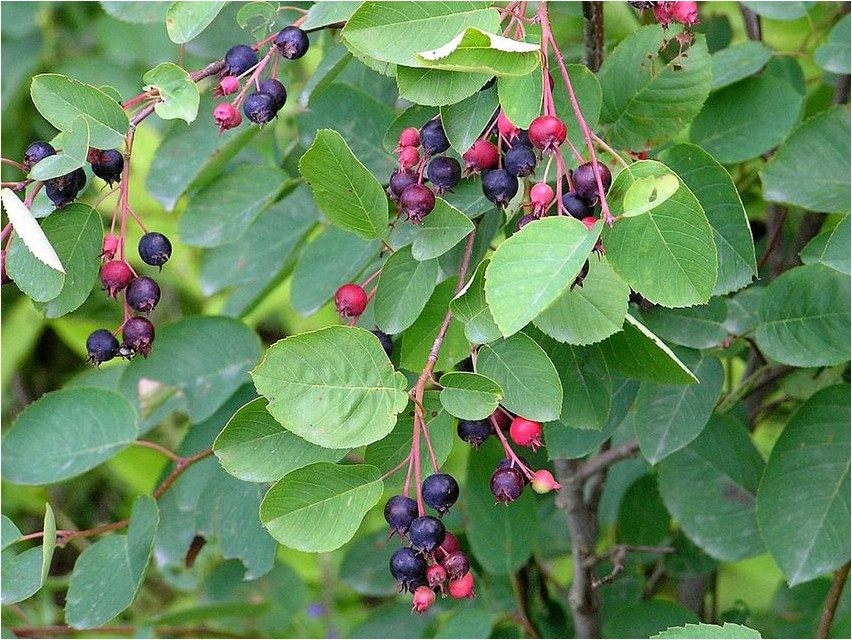
Irga oval is one of the plants of the family called Rosaceae; in Latin the name of this plant will be as follows: Amelanchier ovalis.
As for the name of the oval shadberry family itself, in Latin it will be: Rosaceae Juss.
Description of shadberry oval
Irga oval is a shrub whose height will vary between half a meter and three and a half meters. The leaves of this plant are entire, only a few may be jagged near the apex; such leaves are leathery and oval in shape. The leaves of the oval serviceberry will be rounded on both sides, bare on top, and covered below with dense felt, which also covers the shoots. The flowers are located in four to six flower racemes, the pedicels of the upper flowers are approximately five to ten millimeters, while the lower ones have a length of twenty millimeters. The felt pubescence is quite dense and will persist for a long time. The petals are obverse-oval in shape, their length is eight to ten millimeters, and their width is four millimeters; on the outside, such petals will be hairy.
Under natural conditions, shadberry oval is found in the Crimea and the Caucasus. For growth, the plant prefers rocks, dry calcareous slopes, bushes, edges and bright places up to an altitude of 1900 meters above sea level. As for its general distribution, this plant can be found in Armenian Kurdistan, Asia Minor and the Balkans.
Description of the medicinal properties of shadberry oval
Irga oval is endowed with very valuable healing properties, and it is recommended to use the bark, leaves and fruits of this plant for medicinal purposes.
The presence of such valuable healing properties is explained by the content of tannins, phenolcarboxylic acid and its derivative isochlorogenic acid in the plant. The fruits of this plant contain catechins, flavonoids, tannins, carotene, vitamin C and P, as well as the following carbohydrates: galactose, glucose, polysaccharide, arabinose, rhamnose and xylose. In addition, the plant contains cobalt, lead, copper, beta-sitosterol, organic acids, phenolcarboxylic and other carboxylic acids, as well as their derivatives.

Remedies prepared from this plant are recommended for the prevention and treatment of atherosclerosis, gastrointestinal, and cardiovascular diseases. The plant is a good multivitamin, used to prevent and treat hypo- and avitaminosis of vitamins C, A, and P. The juice of fresh Amelanchier ovale fruits has astringent properties; in folk medicine, this juice is used for gargling and for inflammation of the mouth and throat. Decoctions prepared from the bark and leaves of this plant should be used as an enveloping and astringent remedy for various gastrointestinal ailments, and also as a poultice to heal purulent wounds.
For diarrhea, enterocolitis, and colitis, the following Amelanchier ovale remedy is recommended: to prepare this remedy, take two tablespoons of crushed dried leaves per 300 milliliters of water. The resulting mixture should be boiled for five minutes, then left to steep for one hour, after which the mixture is thoroughly strained. Take this shadberry-based remedy, one-third of a glass three to four times daily.
For diarrhea, gastritis, colitis, and enterocolitis, use the following remedy: take ten grams of crushed shadberry bark per glass of water. Boil the resulting mixture for ten to twelve minutes in a water bath, then let it steep for an hour and strain. Take this remedy, one-half to one-third of a glass, three to four times daily.





