Willow
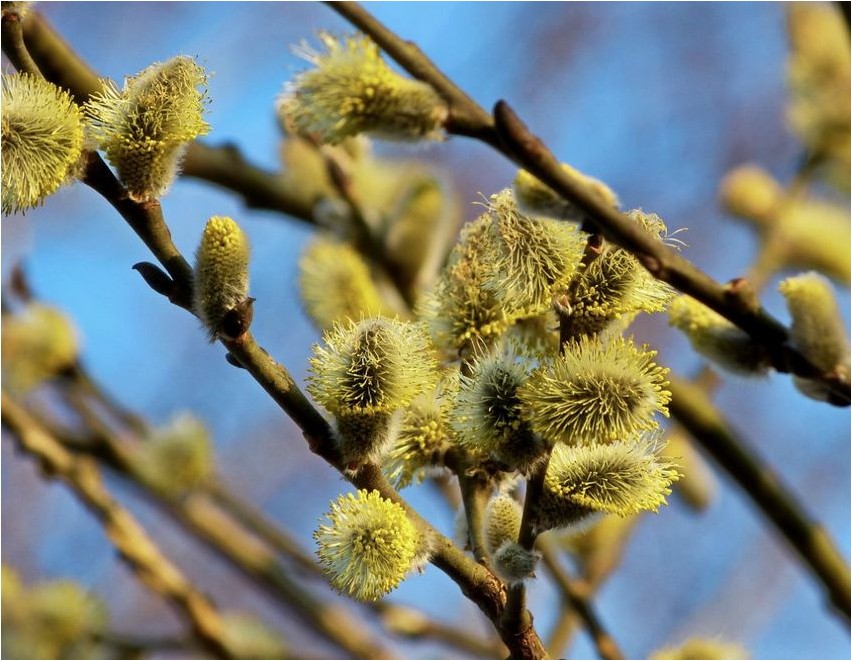
Willow (lat. Salix alba) is a tree or shrub plant belonging to the Willow family.
Description
The willow is a rather attractive shrub or tree, the height of which can reach thirty meters and a diameter of one and a half meters. Each tree is covered with fairly hard dark gray bark and is equipped with spreading paniculate crowns. And upon careful examination, you can notice a huge number of deep cracks on the bark.
Lanceolate, rather long and very beautiful silvery-silky willow leaves are pointed at the tips. All of them sit on short petioles and have jagged edges.
Attractive yellowish-greenish willow flowers are collected in spectacular elongated earrings. As a rule, willow blooms in April or May. And its fruits, which look like boxes, ripen in May and June.
Willow is endowed with the ability to form a truly incredible number of diverse hybrid forms with other representatives of the Willow family.
Where does it grow
It is not difficult to see willow in Russia (mainly in the European part), in Central Asian territory and in the Siberian expanses, as well as in the Caucasus and the Urals. She loves all kinds of bushes, picturesque water meadows and river banks.

Application
Willow is widely used for extremely poor appetite and asthenic syndromes. It will also serve well against malaria (willow is an excellent substitute for quinine) or a wide variety of infectious diseases. At the same time, bark is mainly used for such purposes.
A decoction of the bark is often drunk for diarrhea, as it is an excellent astringent. In addition, it copes well with inflammation and is often prescribed to those suffering from gout and various joint diseases.
Willow bark boasts a pronounced tonic effect and helps perfectly with low blood pressure. An infusion of its leaves and bark is also used externally — for furunculosis, the presence of trophic ulcers, all kinds of skin ailments and excessive sweating of the feet. And in case of inflammatory processes in the mucous membrane of the nasopharynx or mouth, it will become an effective rinse. Quite often, willow is used for inflammation of the mucous membranes of the colon and stomach, as well as for bleeding from internal organs and sore throat.
Bark is usually harvested in the spring from two or three year old shoots. This is done during the period of sap flow — in this case, the bark will very easily lag behind the wood. In order to harvest bark, they first cut or chop off willow branches, and only then begin to free them from the bark. The raw materials obtained in this way are dried on floors or in the attic. However, you can simply hang the bark in the shade on hangers specially designed for this, or use dryers in which the temperature does not exceed fifty degrees. The bark will be considered completely dried only if, when you try to bend it, it does not bend, but breaks with a bang.
In a number of countries in the subtropical and temperate zones, willow is often cultivated as a spectacular ornamental plant.
Contraindications
Pregnant women are strictly prohibited from using willow for medicinal purposes.
Growing and care
Willow can tolerate not only excessive moisture and shading, but also some soil salinity, as well as short-term flooding. And if its trunk and underground organs are under water for a long time, moss-like roots will begin to form on the trunk, facilitating the best absorption of oxygen and moisture by the tree.