Kuril tea
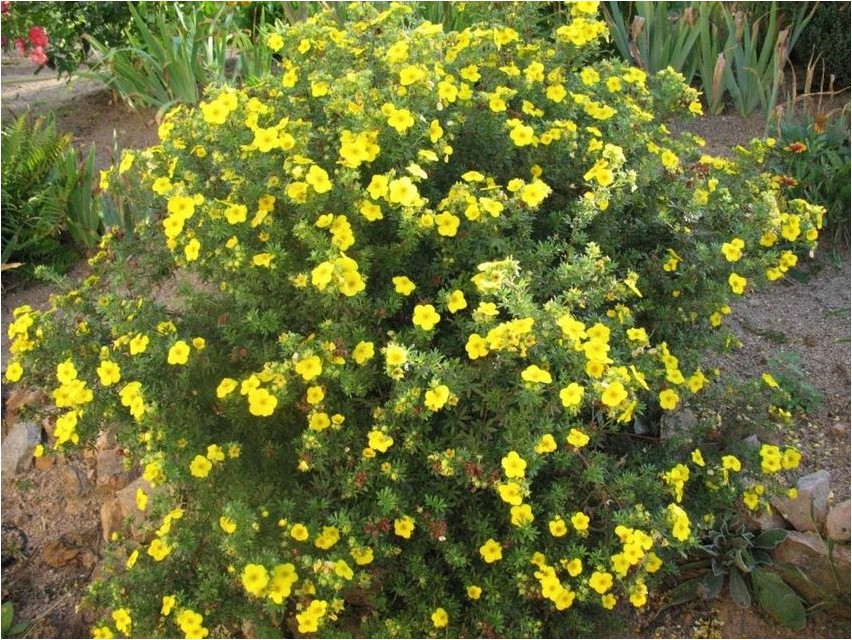
Kuril tea (lat. Potentilla) is the largest genus of flowering plants in the Rosaceae family. Other names are cinquefoil, cinquefoil, dasiphora.
The genus got its name from the Latin word “potents”, which translates as “strong”, “powerful”. The name indicates the effective healing properties of the representatives of the genus. The genus contains about 180 species, of which 10 are woody plants, the rest are classified as herbaceous. Previously, Kuril tea was assigned to the genus Cinquefoil, but today most of it was assigned to the genus Cinquefoil. Natural range — North America and Eurasia. Typical habitats are mountain forests, river and lake banks, meadows, rocky slopes and bushes.
Characteristics of culture
Kuril tea is a prostrate deciduous subshrub or shrub up to 150 cm high, which forms dense thickets as it grows. The branches are covered with gray flaking bark. Young shoots are silky. The leaves are trifoliate or odd-pinnate, equipped with membranous stipules. The flowers are five-petaled, solitary or collected in umbellate or racemose inflorescences. The fruit is a densely pubescent achene.
The most common representative of the genus is Kuril bush tea, or bush cinquefoil (lat. Potentilla fruticosa) — a low-growing shrub with a spherical crown and yellowish branches. The flowers of the species in question are golden or golden-yellow, reach 2-3 cm in diameter, and are collected in corymbs located at the tops of the shoots. Kuril bush tea blooms in June — October. Flowering is abundant and long lasting. Currently, about 100 varieties have been bred.
An equally striking representative of the genus is considered to be Kuril tea Daurian, or Daurian cinquefoil (lat. Potentilla davurica) — a low-growing shrub with pubescent gray shoots. Cinquefoil is most often found in the Far East, Korea and China. The flowers are white, collected in umbellate inflorescences. Blooms from June to mid-October. The fruits are dry, brown.
On the territory of Russia, the Manchurian cinquefoil species (lat. Potentilla mandschurica) is often found. Externally, the plant is similar to Dahurian cinquefoil, differing only in its densely pubescent leaves. The species in question blooms 4-5 years after planting.

Friedrichsen”s cinquefoil (lat. Potentilla x friedrichsenii) is of hybrid origin. This species was obtained by crossing Dahurian cinquefoil and shrubby cinquefoil. The species is represented by low shrubs with a spherical crown and cream or pale yellow flowers. Blooms from June to October.
Growing conditions
Kuril tea is undemanding to soil conditions and grows normally on calcareous and acidic soils. Waterlogged soils are treated negatively. Accept heavy loamy soils, but subject to good drainage. The location is preferably intensely lit; shadow has a negative effect on flowering. Some species and varieties require diffused light. Representatives of the genus with pink or red flowers need fertile and moderately moist soil.
Features of cultivation
Kuril tea is planted in early spring. The optimal distance between plants is 60-90 cm. Planting holes are prepared in advance; their depth should be about 50 cm. The root collar of seedlings should be located at soil level; deepening is undesirable.
Kuril tea is propagated by seeds and cuttings. Sowing is carried out in the fall. Spring sowing is not prohibited, but in this case the seeds need preliminary stratification for three months at a temperature of 5C. Cuttings are also possible. As a rule, up to 80-100% of cuttings take root.
Kuril tea has increased drought-resistant properties, but requires regular and moderate watering. The culture responds positively to fertilizing. For these purposes, it is recommended to use complex mineral fertilizers at the rate of 100 g per 1 square meter. In the spring, it is necessary to apply potassium and phosphorus fertilizers; they will increase the flowering time.
Kuril tea easily tolerates rejuvenating and sanitary pruning. Every year, the shoots of shrubs are shortened by 10 cm; this procedure will give the shrubs a more compact shape. The crop is extremely rarely affected by diseases and pests.
Application
Species and varieties that are cold-resistant and unpretentious to growing conditions are widely used in ornamental gardening. They look harmonious in alliance with conifers and other beautiful flowering shrubs and trees. In the form of compact groups, Chinese tea looks great on the lawn. Low-growing varieties are suitable for creating rock gardens and other rocky flower beds. For borders and hedges, cinquefoil is ideal.


