Helianthemum nummularium
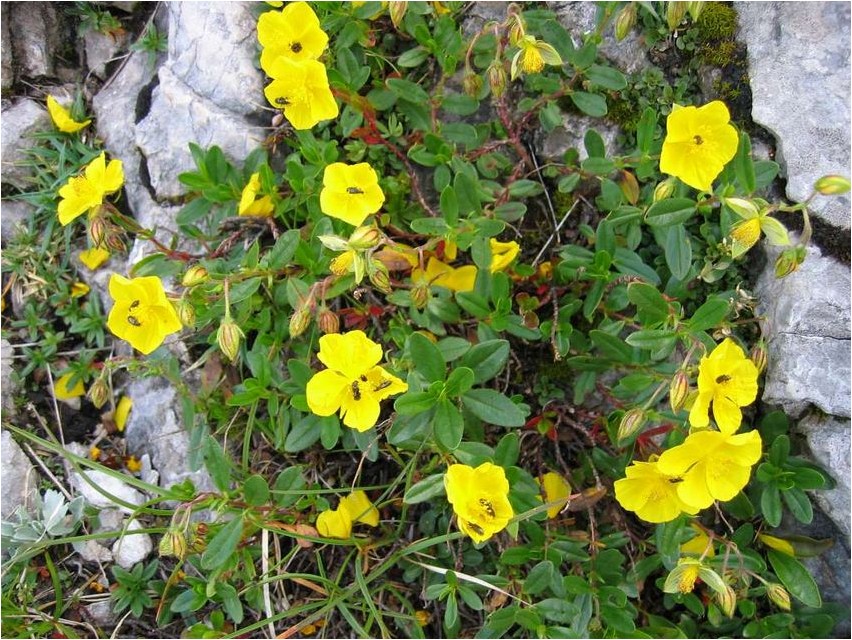
The Helianthemum nummularium is a member of the Cistaceae family. Its Latin name is Helianthemum nummularium (L.) Mill. (H. vulgare auct. PP.).
The family name of the Helianthemum nummularium is Cistaceae Juss.
Description of the Helianthemum nummularium
The Helianthemum nummularium is a subshrub, reaching a height of between ten and forty centimeters. This plant is highly branched and has ascending shoots. The lower stems of the Helianthemum nummularium are woody and can be dark brown or grayish-brown in color. The leafy stems of this plant are divided into segments by transverse ring-shaped leaf scars. The leaves of the Monet-leaved helianthus are approximately four to twenty-five millimeters long and three to eight millimeters wide. These leaves are opposite, oblong-oval in shape, and glaucous-tomentose beneath. Whorls of three to eight flowers are borne on densely tomentose peduncles. The petals are approximately seven to eleven millimeters long and feature a darker spot located at the base. These petals can range in color from orange-yellow to yellowish-pink, and the seeds are dark purple.
The helianthus flowers from May to August. In the wild, this plant is found in Crimea, the Caucasus, Ukraine, Moldova, and the European part of Russia, with the exception of the Lower Volga and Trans-Volga regions. In terms of general distribution, this plant can be found in Asia Minor, Central Europe, and the Balkans. The nummulifolia helianthus prefers pine and shrub forests, as well as chalk, limestone, and rocky mountain slopes, all the way up to the upper alpine zone. It’s worth noting that this plant is not only a valuable honey plant but also highly ornamental.
Description of the medicinal properties of the nummulifolia helianthus
The nummulifolia helianthus possesses valuable medicinal properties, and it is the herb of this plant that is recommended for medicinal purposes. The herb includes the flowers, stems, and leaves.
It should be noted that the herb sunflower coinifolia has become quite widespread in homeopathy. An infusion prepared from the leaves of this plant is indicated for use as a very effective wound healing and astringent. In addition, this infusion based on the herb of the sunflower is used for colitis and dysentery. It is noteworthy that the leaves of this plant are quite suitable for use for tanning leather.

For colitis and dysentery, it is recommended to use the following very effective healing remedy based on this plant: to prepare such a healing remedy, you will need to take ten grams of crushed dry leaves of the sunflower coinifolia per one full glass of boiling water. The resulting medicinal mixture should first be left to infuse for about two hours, after which this mixture based on this plant must be filtered very carefully. As an astringent medicine for colitis, this remedy is taken two to three tablespoons. In addition, such a medicinal product based on sunflower monetifolia can be used as a wound-healing agent in the form of a lotion.