Kudrania
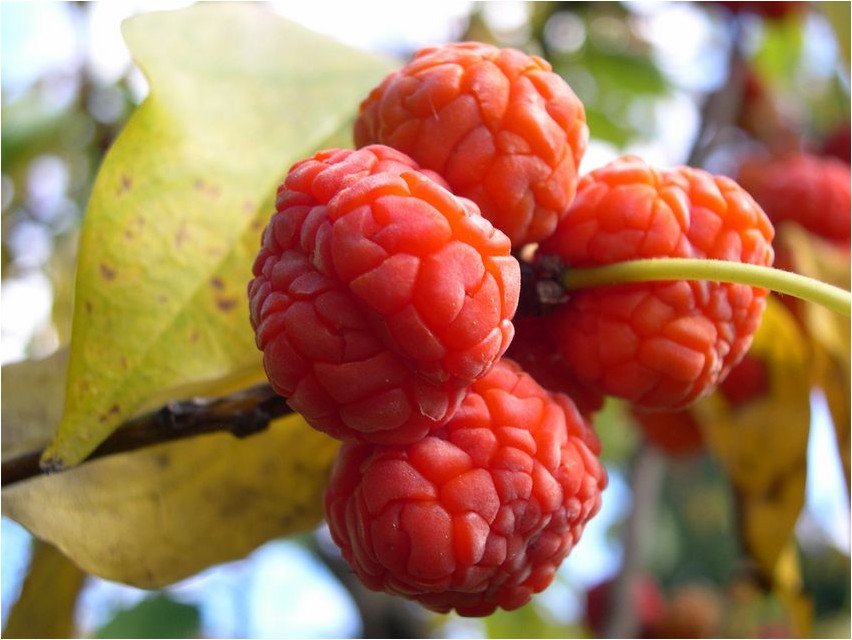
Kudrania (lat. Cudrania tricuspidata) is a deciduous fruit tree belonging to the Mulberry family. This plant is often called the strawberry tree, and in science it is called Triacum triacum.
Description
Kudrania is a deciduous dioecious tree of relatively small size: as a rule, its height does not exceed six meters.
The small leaves of this crop are painted in pale yellowish-greenish tones. The leaves of kudrania, as well as the reddish pulp of its juicy fruits, contain whitish juice.
Kudrania fruits in appearance resemble the familiar mulberry, and their taste is somewhat similar to the taste of persimmon. They are complex polydrupes reaching from two and a half to five centimeters in length, turning reddish or dark burgundy-reddish as they ripen. The red pulp of the fruit contains several brownish miniature seeds, which have an external resemblance to hemp nuts.
In the subtropical conditions of the Black Sea coast, in particular in the botanical garden in Batumi, kudrania ripens approximately in November.
Where does it grow
Kudrania is a plant native to East Asia, where it is cultivated for its edible, sweet fruit. Currently, it is grown in many countries, although only in those where climatic conditions are favorable for its growth. Wild thickets of kudrania can be found in Afghanistan and Iran — there it is grown not only for its fruits, but also for the purpose of fixing soil and decorative landscaping.

Despite the fact that kudrania is a very heat-loving crop, capable of growing only in subtropical and tropical zones, some amateur gardeners manage to grow it in the Transcaucasus, in a number of southern Russian regions and even in Ukraine.
Application
Kudrania fruits are eaten both raw and processed — they are used to make excellent compotes, prepare wonderful jams and make fragrant preserves. And fresh fruits attract gourmands with their sweetness and incredible juiciness.
These attractive berries have a low acid content and a very decent sugar content. They are useful to use for heavy periods, anemia, heartburn and dysentery, as well as stomach and duodenal ulcers. In addition, berries help restore the functioning of the spleen and liver, normalize metabolism, cleanse and improve blood health, and lower blood pressure.
Other parts of this plant have also found their uses. For example, a decoction of the bark of the beautiful kudrania, which has pronounced bactericidal properties, promotes the rapid healing of almost any wound. The powdered bark is first infused in vegetable oil and then applied to ulcers, burns, and wounds.
The incredibly dense wood with its incredibly beautiful texture makes kudrania a wonderful material for making all kinds of handicrafts and striking furniture. This wood is also used to make all kinds of musical instruments.
Contraindications
Avoid using kudrania if you have stomach problems, allergic reactions, or individual intolerances.
Cultivation
Kudrania is a very heat- and light-loving plant, easily tolerating prolonged drought. Its incredibly strong root system helps this plant survive drought. Watering should be moderate. In well-drained, fertile soils, kudrania produces rich harvests—a single ten-year-old tree can yield up to two hundred kilograms of fruit.
Kudrania is propagated not only vegetatively—it reproduces just as well by seed, and it begins to bear fruit in its fifth to seventh year.
The exotic “raspberry” tree, the “strawberry” tree—kudrania