Kethembilla
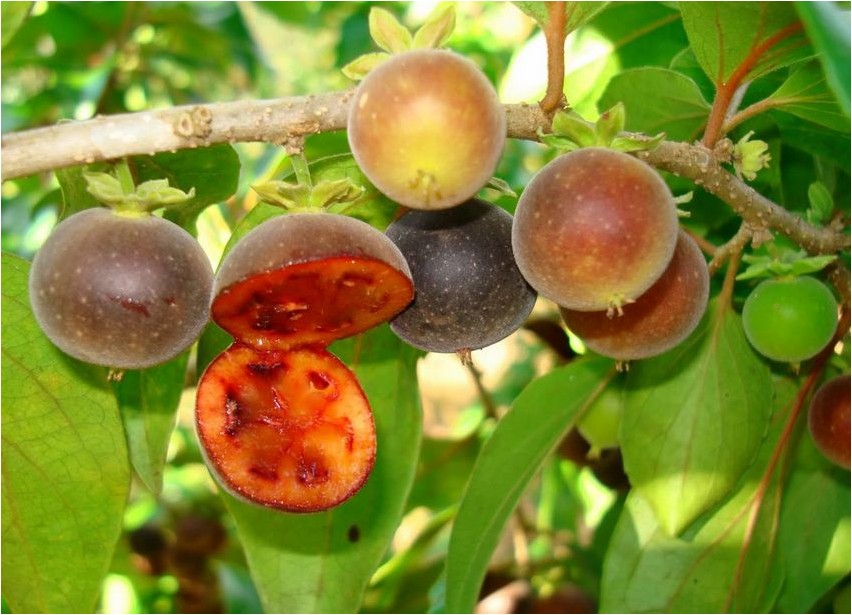
Ketembilla (lat. Dovyalis hebecarpa) is a fast-growing fruit tree belonging to the Willow family. This crop, which is a close relative of the Kaffir plum, is popularly called Ceylon gooseberry.
Description
Kethembilla is a small, fast-growing deciduous tree whose height ranges from four and a half to six meters. The branches of this crop are densely strewn with sharp thorns — their length can reach four centimeters. Most of the thorns can be seen on the lower branches and on the trunks.
The finely velvety and oval leaves of ketembilla are colored in grayish-greenish tones and are endowed with pale pink petioles. And in length they reach from seven to ten centimeters.
The diameter of the petalless greenish-yellow flowers is about 1. 25 cm. Ketembilla is a monoecious tree, pollinated only by insects. As for the diameter of the spherical ketembilla fruits, it can vary from 1. 25 to 2. 5 centimeters. All fruits are covered with a velvety and fairly hard thin skin, and their color range can vary from orange (if the fruit is not ripe) to dark purple tones. The purple-red and incredibly juicy pulp of the fruit has a sour taste and contains nine to twelve seeds about six millimeters long.
The average lifespan of each fruit tree is about seventy years.
Where does it grow
Sri Lanka is considered the birthplace of ketembilla — there this culture can be found at an altitude of about eight hundred meters above sea level. It is currently introduced and grown in the Philippines, Cuba, as well as Puerto Rico, Hawaii and South Florida.

Application
Most often, ketembilla fruits are used to make jams and jellies. True, it is quite acceptable to consume them fresh (ideally with sugar). The fragrant ketembilla juice is often added to ice cream and some other fruit juices, and is also used in the manufacture of various cocktails and in confectionery production. These fruits are also used to make excellent sauces, salad dressings and marinades.
Unripe kethembilla fruits are very rich in pectin, which is why they are widely used to make marmalade. In addition, you can make jam from unripe fruits and make wonderful jams. And if you ferment these fruits, you can get great wine.
Ketembilla is an excellent general tonic. It will be very useful for anemia and during breastfeeding. In addition, it is an excellent tool for rehabilitation in the postoperative period.
And in gardening, ketembilla is widely used to create incredibly picturesque hedges.
At room temperature, ketembilla can be stored for no more than two days. And if you place it in a cool enough place, it will easily keep for one and a half to two weeks.
Contraindications
As such, there are no contraindications to the use of ketembilla; however, sometimes allergic reactions due to individual intolerance cannot be ruled out.
Growing
Kethembilla grows best in light, well-drained, nutrient-rich soils. Sandy soils are especially good for growing it. This plant is very light-loving and needs plenty of moisture — especially at the fruiting stage.
Ketembilla is propagated by cuttings or seeds. In tropical conditions, the fruit is often harvested twice a year, and in the subtropics, ketembilla bears fruit from spring until early summer. In Israel, fruit ripening occurs from winter to spring.