Siberian pennyweed
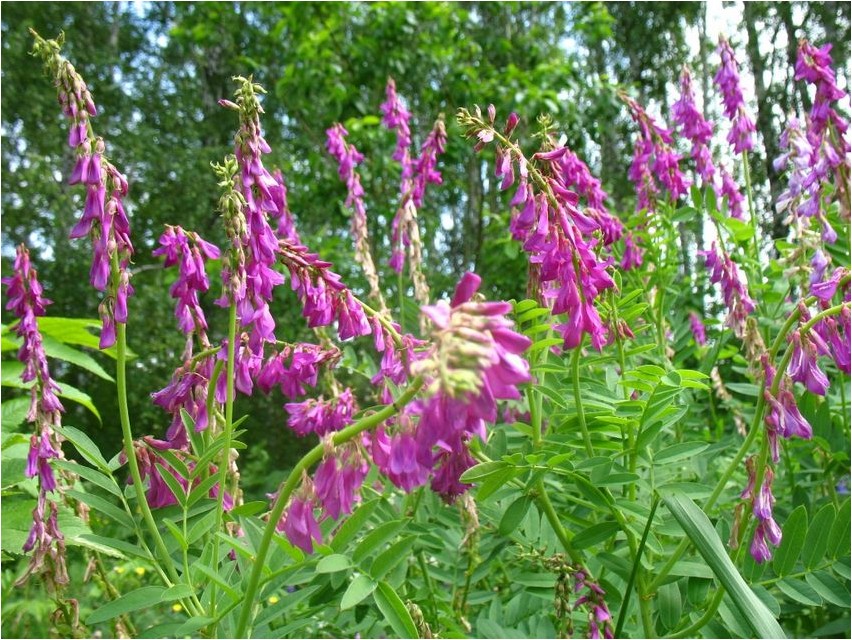
Siberian pennyweed is one of the plants of the family called legumes; in Latin the name of this plant will be as follows: Hedysarum sibiricum Poir.
As for the name of the Siberian pennyweed family itself, in Latin it will be: Fabaceae Lindl.
Description of the Siberian pennyweed
Siberian kopek is a perennial herbaceous plant, endowed with numerous erect leafy stems, the height of which will be about one hundred to one hundred and twenty centimeters. The leaves of this plant will be odd-pinnate, they bear approximately five to nine pairs of oblong-ovate or elongated blunt leaves. The inflorescences of this plant are rather long and thick racemes, which will be endowed with numerous flowers, painted in dark pink or lilac-violet tones. The fruits of the Siberian kopek are beans with two or three segments. Such members will be appressed or naked, they will have no margin or a very narrow margin.
The Siberian kopekweed blooms from June to July, and the fruits will ripen in late August and early September. Under natural conditions, this plant is found in the European part of Russia, in the Amur region in the Far East, in the European Arctic, in Western and Eastern Siberia. For growth, this plant prefers coastal cliffs, slopes, pine forests, forest meadows, edges and birch forests.
Description of the medicinal properties of Siberian kopek
Siberian kopek is endowed with very valuable healing properties, and it is recommended to use the roots and herbs of this plant for medicinal purposes. The grass of this plant should be harvested during the budding period or at the very beginning of the flowering period. The leafy part of the stems of Siberian kopeks should be cut at a height of approximately ten to twenty centimeters from the very surface of the soil. It is recommended to dry the cut mass of this plant in the shade with very good ventilation or in dryers. Dried Siberian kopek grass should be threshed, removing thick and coarse stems. The shelf life of such raw materials will be two years.
In folk medicine, a decoction made from the herb of this plant is quite common. This decoction is used as a pain reliever and as a compress for headaches. A decoction prepared from the roots of Siberian Hedysarum is used as a sedative, tonic, anticonvulsant, expectorant, and antipyretic. This decoction is also recommended for intestinal colic and atherosclerosis.

A powder made from the roots of Siberian Hedysarum is used for epilepsy. For atherosclerosis, the following remedy based on this plant is recommended: to prepare this remedy, add one tablespoon of crushed dried Siberian Hedysarum herb to 300 milliliters of boiling water. Let the mixture steep for approximately two hours, then strain thoroughly. Take this remedy three times daily, one-third of a glass at a time.
For poor sleep and irritability, use the following remedy: to prepare this remedy, take one tablespoon of crushed roots per two glasses of water. Boil the resulting mixture for five minutes, let it steep for one hour, and then strain thoroughly. Take the resulting remedy three to four times daily, one-third of a glass at a time.