Tulip Tree
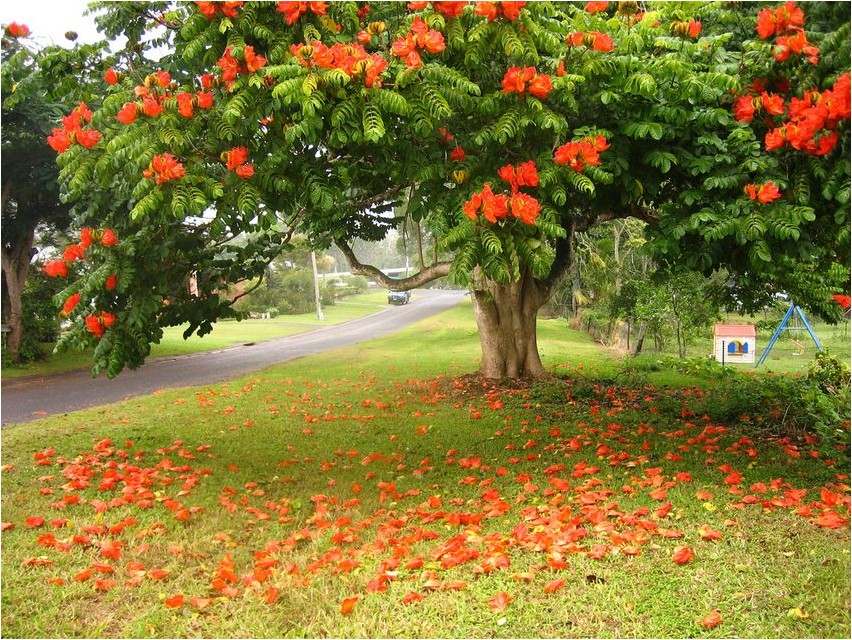
The tulip tree, or Liriodendron tulipifera, is a species of the genus Liriodendron in the Magnoliaceae family. It is native to eastern North America.
It is currently cultivated in tropical and subtropical regions. In Russia, the tulip tree is only cultivated in the Krasnodar Krai, where it is widely used in landscape design.
Cultural Characteristics
Liriodendron tulipifera is a highly ornamental deciduous tree characterized by rapid growth. Tree heights range from 3 to 60 meters. The crown shape is pyramidal or oval. Young specimens have smooth, grayish-green bark; mature specimens have uneven bark with distinct, whitish diamond-shaped grooves. The tulip tree”s trunk is straight, reaching 60-150 cm in diameter. The leaves are simple, light green, broad, lyrate-shaped, composed of four lobes, alternate, with pinnate venation, up to 20 cm long, borne on long petioles and equipped with large stipules that encircle the branches. With the onset of autumn, the foliage turns golden yellow.
The flowers are voluminous, resembling tulip buds. The perianth is three-parted, consisting of three leaflets curved outward. The tulip tree blooms profusely and spectacularly, blooming in late May to early June.
The cone-shaped, oblong fruit, up to 5 cm long, consists of samaras, which fall off when ripe. The samaras have a single wing and a tetrahedral seed, which is attached at one end to the wing and at the other to the cone-shaped spike. The fruits typically ripen in August–October.
Growing Conditions

Under favorable growing conditions, the tulip tree will delight its owners with lush, abundant blooms and rapid growth. The plant thrives in deep, well-drained soils. The plant is also tolerant of sandy soils, but will not tolerate saline, highly acidic, calcareous, or waterlogged soils. Organic soil plays a significant role in the normal development of the tulip tree. The plant also requires a lot of light, so it is recommended to grow it in brightly lit areas.
Propagation
The tulip tree is propagated by seeds, cuttings, layering and grafting. Seeds are sown in autumn in seedling containers filled with well-drained, sandy soil. Crops are exposed to a cool place with high air humidity. Seedlings are transplanted in May-June of the next year, by which time they reach a height of 15-20 cm. Young plants are planted in the ground a year later — in April — May.
Reproduction by layering is carried out in March. To do this, flexible branches located closer to the soil surface are placed in grooves and dug in, but the apical part should be located on top. After the cuttings take root, they are separated from the mother plant and transplanted to a permanent place.
Care
Watering should be regular, without waterlogging or drying out. Fertilizing with organic and mineral fertilizers alternately 2-3 times per season. When growing lyriodendron as an indoor crop, the plants are fed 2 times a month in spring and summer, and once a month in autumn and winter. The crown of a tulip tree is formed by pruning. Sanitary pruning is required. The crop is resistant to diseases and pests. Rarely affected by aphids.
Tulip tree or Liriodendron tulipum