Rhodiola frosty
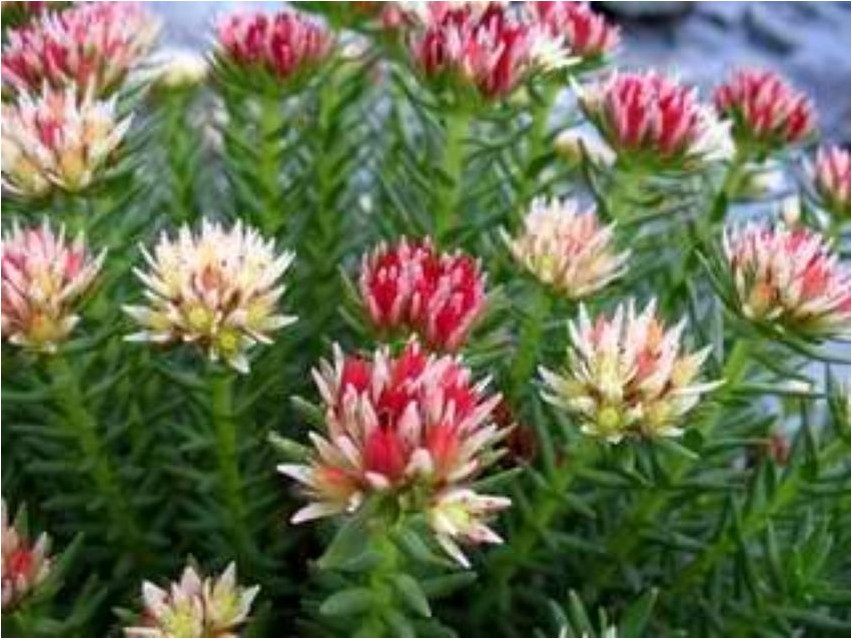
Rhodiola frostis is one of the plants of the family called Crassulaceae; in Latin the name of this plant will be as follows: Rhodiola algida (Ltdeb.) Fisch. et Mey.
As for the name of the Rhodiola frosty family itself, in Latin it will be: Crassulaceae DC.
Description of Rhodiola frosty
Rhodiola frostis is a perennial herbaceous plant whose height will vary between six and eighteen centimeters. The root of this plant is quite thick and long, while the rod will be multi-headed, and it is covered with triangular and scale-like leaves. The stems of Rhodiola frostis are densely leafy and numerous, their height is about six to eighteen centimeters, and their diameter is one and a half to two and a half millimeters. The leaves of this plant will be flat and alternate, linear, entire and sessile, their length is about eight to twenty millimeters, and the width will be one and a half to three millimeters. The inflorescence of this plant is a dense and simple corymb, the flowers are five-membered, usually they will be bisexual, while sometimes the pistillate flowers may also be underdeveloped. The corolla of Rhodiola frostis is quite large in size, it is one and a half to two times longer than the calyx itself. The length of the petals is seven to eight millimeters; such petals can be painted in dirty pink or white tones. The length of the leaflets is seven to ten millimeters, they will be dark red in color. The length of the brown seeds is two millimeters, they are lanceolate.
Frosty Rhodiola blooms from June to July. Under natural conditions, this plant is found in the Altai region of Western Siberia, as well as in the Daursky and western Angara-Sayan regions of Eastern Siberia. For growth, this plant prefers places near watercourses, ancient moraines, places near snowfields, river banks, gravelly-lichen tundra, rocky slopes and rocks.
Description of the medicinal properties of Rhodiola frostis
Rhodiola frostis is endowed with very valuable healing properties, and it is recommended to use the rhizomes and roots of this plant for medicinal purposes. The presence of such valuable healing properties should be explained by the content of carbohydrates and the following related compounds in the roots of Rhodiola frostis: D-mannitol, glucose, sedoheptulose, fructose and sucrose; in addition, the plant contains tannins, flavonoids, acetylrhodaline, organic acids, phenols and their derivatives. The aerial part of Rhodiola frostis, in turn, will contain anthraquinones, coumarins, flavonoids and tannins.
As for traditional medicine, here this plant is quite widespread. Traditional medicine recommends using preparations based on this plant for various female diseases, jaundice and epilepsy.

It should be noted that the experiment proved that this plant has the ability to stimulate the central nervous system, provide anti-hypnotic and anticonvulsant effects, and will also inhibit the development of leukemia. It is noteworthy that the roots and rhizomes of Rhodiola frostis can serve as medicinal raw materials for the production of drugs that have a psychostimulating effect.
Rhodiola frostis is a very ornamental plant and will also need protection. In addition, it is recommended to introduce this plant into cultivation in order to expand its growing area and increase the population of Rhodiola frostis itself.