Nandina
Nandina (lat. Nandina) is a decorative deciduous flowering plant from the Barberry family.
Description
Nandina is a relatively compact evergreen tree, the height of which can reach five to six meters. Sometimes such trees can grow in a bushy manner and are characterized by a very shallow root system. Each tree boasts a luxurious openwork cylindrical crown and slightly branched, erect side shoots. All shoots are covered with fairly strong longitudinally furrowed bark, which is initially colored in light brown-violet shades, and then in grayish-brownish tones.
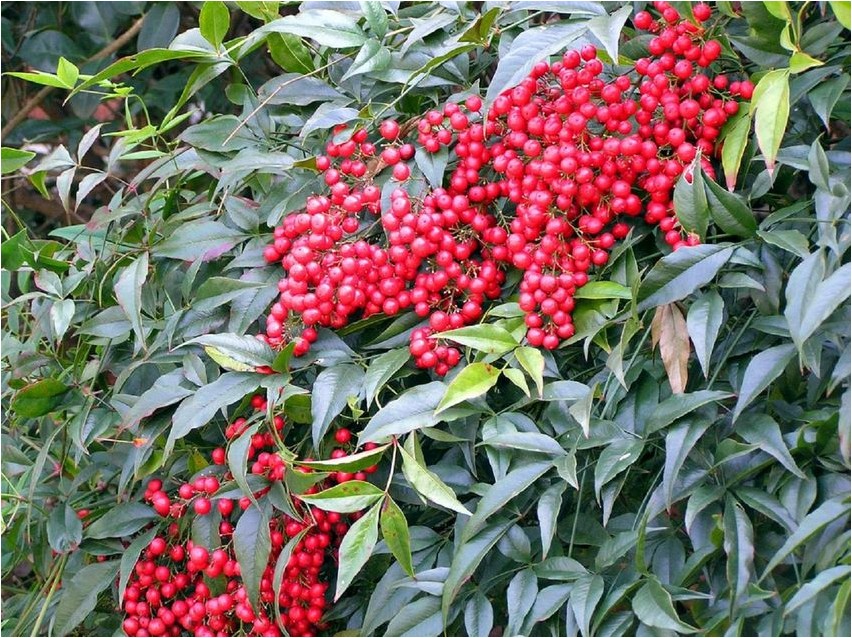
Nandina leaves usually cluster in the upper parts of the branches, and their length is often between thirty and forty centimeters. All leaves are triply pinnate, compound and triangular in shape with wedge-shaped bases and pointed apices. In addition, they are always shiny and quite dense. With the onset of autumn, the once dark green leaves acquire a red or red-brown color, and they remain in this form until spring.
Nandina inflorescences form incredibly cute apical panicles, the length of which varies from twenty to forty centimeters. The diameter of the flowers can reach six millimeters, and each flower is equipped with three spirally arranged sepals of a yellowish-whitish color, and these sepals gradually turn into beautiful white petals.
Nandina berries are usually colored a rich, bright red color, although sometimes white berries are also found. All of them are equipped with slightly pointed tips and reach eight millimeters in diameter.
Nandina usually flowers in June-July and bears fruit in September-October.

Where does it grow
In nature, nandina can be found mainly in Japan and China. This plant has naturalized quite well in the vast expanses of North America. It grows mainly on mountain slopes.
Usage
Nandina is very widely used as an ornamental plant — they especially like to grow it for these purposes in the Caucasus, Crimea and a number of subtropical regions of Russia. It is equally suitable for planting as a tub crop, and for planting on the edges, as well as in single or group plantings. In addition, nandina feels great in winter gardens and greenhouses.
Growing and care
Nandina will grow best in a soil mixture formed by turf and leaf soil in combination with sand (the proportions in this case should look like 4:2:1). Universal ready-made mixtures are also quite suitable for growing it. This plant should ideally be placed in fairly cool southern rooms.
Despite its love of light, in the summer season nandina needs shading from the direct rays of the heavenly body. And during the rest period, it is extremely important to try to provide this unusual beauty with a temperature in the range from seven to thirteen degrees.
Nandina should be watered moderately most of the year (this applies to both volume and frequency), and in winter — even less often. This plant does not need spraying at all.
During the active growing season, nandina needs to be fed with combined fertilizers — as a rule, this is done once or twice a month, not more often. Also, pruning should be done from time to time to form a crown.
Nandina can be propagated either by root suckers or sowing seeds, or by grafting or cuttings. It is important to take into account that it will grow slowly in all cases.