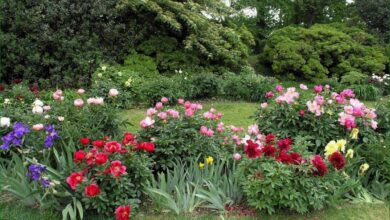
Heather
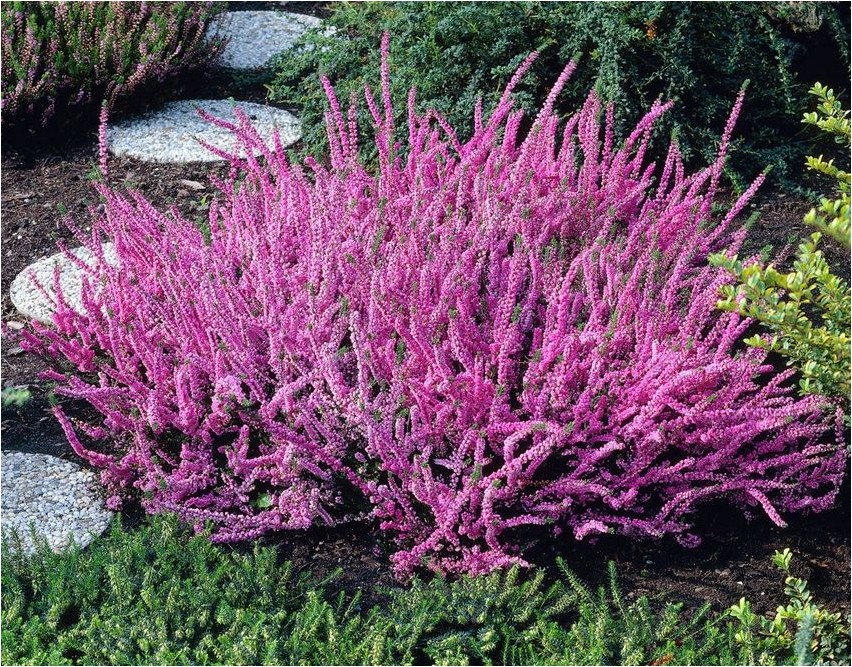
Heather (lat. Calluna) is a genus of shrubs of the Ericaceae family. The only representative of the genus is the common heather (lat. Calluna vulgaris).
In nature, heather is found in North Africa, Greenland, North America, temperate Asia and Europe. In Russia, the plant grows in Eastern and Western Siberia, the Urals, as well as the European part. Typical places are pine forests, peat bogs and burnt areas.
Characteristics of culture
Heather is a dwarf, highly branched shrub up to 0. 6 m high with outstretched rigid branches and a rounded crown. The root system is compact, the main part of the roots lies close to the soil surface. The leaves are small, green, scaly, needle-shaped, arranged spirally or in rows. In autumn, the foliage takes on a reddish-purple color.
The flowers are numerous, bell-shaped, fragrant, collected in one-sided racemes, and can come in a wide variety of colors, but pink, pink-violet, wine and white shades often predominate. The fruit is a four-lobed capsule containing a large number of small seeds.
The crop blooms from the second or third decade of July to mid-August, but depending on the climatic zones, the flowering time may vary. Pods ripen in early autumn — September-October. On average, one shrub lives 40-50 years.

Growing conditions
Heather prefers well-lit areas; areas with light shading are not prohibited. In full shade, plants lose their decorative properties, since they practically do not form flowers. The optimal soils are fertile, loose, moist, and acidic. High-quality drainage is required, especially for places with compacted soils. Lowland heather with stagnant melt water, as well as heavy compacted and waterlogged soils, are not tolerated.
Reproduction and planting
Heather is propagated by seeds, cuttings, layering and division of rhizomes. The seed method is labor-intensive and time-consuming. First, the seeds are scattered in a thin layer over the container, thoroughly moistened and covered with glass. After about 14-20 days, the seeds will hatch, and only after that they are sown in seedling boxes filled with fresh substrate consisting of fertile soil and peat. The first shoots appear 30-40 days after sowing. The optimal room temperature is 18-20C. It is important to provide seedlings with regular watering. In summer, seedlings are periodically taken out onto the balcony or street, but they are planted in open ground only after 1. 5-2 years.
Propagating heather by layering is one of the most effective and simplest methods. Moreover, the crop can reproduce independently by layering, because over time, the lower shoots of the bushes lie on the soil surface and, accordingly, form roots. Such cuttings are separated from the mother plant and planted in a permanent place.
When propagating by cuttings, planting material is cut from the top of healthy and strong shoots. This procedure is carried out at the end of summer. Before rooting, the cuttings are planted in containers with a substrate consisting of sand and peat in a ratio of 1:3. For successful rooting of cuttings, the room temperature must be maintained at 15-18C. Once every two weeks, planting material is fed with a urea solution; the use of microfertilizers is not prohibited. Already formed young plants are planted in open ground the next year.
When planting heather seedlings, it is important to maintain the optimal distance, which should be at least 40-50 cm. The seedlings are planted together with a ball of earth, but when lowering them into the planting hole, the roots are carefully straightened in different directions. The root collar of the seedling should be located a couple of centimeters above the soil surface. After planting, the soil in the tree trunk area is slightly compacted, then watered abundantly and mulched with sawdust or small wood chips; peat is also suitable for these purposes.
Care
Heather needs systematic feeding with mineral fertilizers. This procedure is carried out in early spring. Fertilizer should not get on the leaves and flowers of the bush, otherwise burns cannot be avoided. Heathers react negatively to heat, so they need to be sprayed in the evening. Watering should also be regular.
Removing weeds and shallow loosening is an equally important procedure for caring for heather. Sanitary pruning of plants is carried out in early spring (before the start of sap flow). Formative pruning is also useful, because without this operation the heathers lose their shape and quickly age. In winter, the tree trunk area is mulched with peat, and the plants are covered with spruce branches. Remove the shelter no earlier than April (depending on the climate zone, the timing may vary).