Silene vulgaris
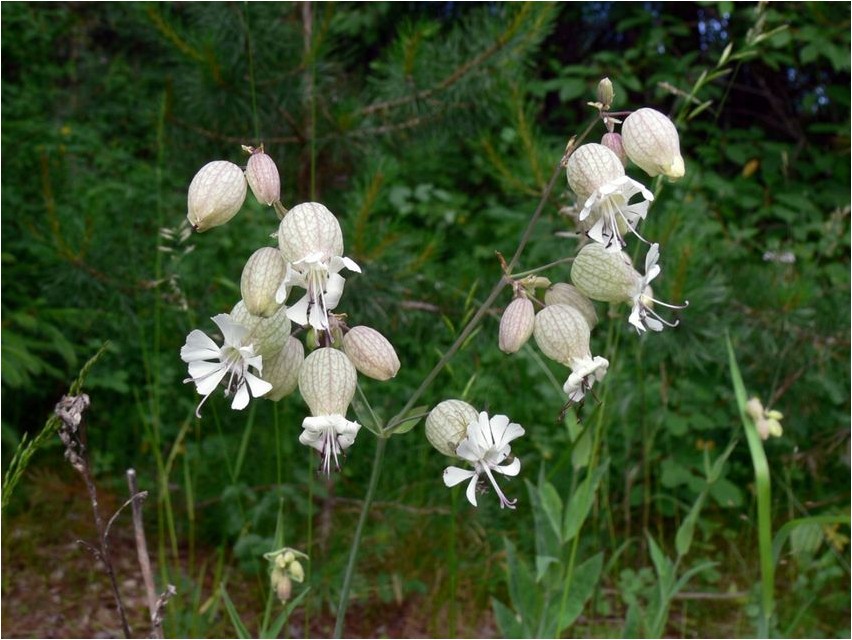
Silene vulgaris is a member of the Caryophyllaceae family. Its Latin name is Silene vulgaris (Moench.) Garcke (S. cucubalus Wib.).
The family name of the common campion is Caryophyllaceae Juss.
Description of Silene
Silene vulgaris, also known as the common campion, is a perennial, glaucous, herbaceous plant that grows between 30 and 60 centimeters tall. Its stems are erect and branched at the top. The leaves of the common campion are somewhat fleshy, opposite, sessile, and pointed. They can be either ovate-lanceolate or lanceolate, with the lower leaves having short petioles. The flowers of this plant are white, borne on rather short, thin peduncles and arranged in a loose paniculate inflorescence. These flowers can be either unisexual or bisexual. The calyx of the common campion is strongly swollen and glabrous, broadly ovate, whitish-green in color, and thirteen to eighteen millimeters long and seven to ten millimeters wide. The petals of this plant are white, one and a half to two times longer than the calyx, and are dissected into obovate lobes almost to the base. The fruit of the common campion is a nearly spherical capsule containing kidney-shaped seeds.
This plant blooms from June to September. In the wild, this plant is found in the Caucasus, Belarus, the Far East, Central Asia, Western and Eastern Siberia, and the European part of Russia. It prefers forest edges, wastelands, roadsides, fallow fields, boundaries, and crop fields.
Description of the medicinal properties of the common campion
The common campion has very valuable medicinal properties, and it is recommended to use the herb of this plant for medicinal purposes. The herb includes the stems, flowers, and leaves. This medicinal raw material is recommended to be harvested throughout the flowering period.
The presence of such valuable medicinal properties can be attributed to the saponin silenoside found in the roots of this plant, while fresh roots contain the carbohydrate lactosin, and the rhizomes, in turn, contain lactosin. The herb of the common campion contains ascorbic acid, sinapic acid, and ferulic acid.

A decoction made from the inflorescences of this plant is indicated for chronic bronchitis, and a decoction of the herb of the common campion is recommended for the treatment of erysipelas. An infusion of the entire flowering plant is a highly effective sedative and is also used for vaginitis, leucorrhoea, and metritis.
For gastritis, which is accompanied by increased acid production in the stomach, preparations based on the herb of the common campion are recommended. These remedies are also used as a diuretic and are used for various kidney and bladder ailments. The herb of this plant is used in baths and has a softening effect, while the juice of the common campion is used for conjunctivitis. In Belarus, the herb is used for dysentery and as a diuretic.





