Camel thorn
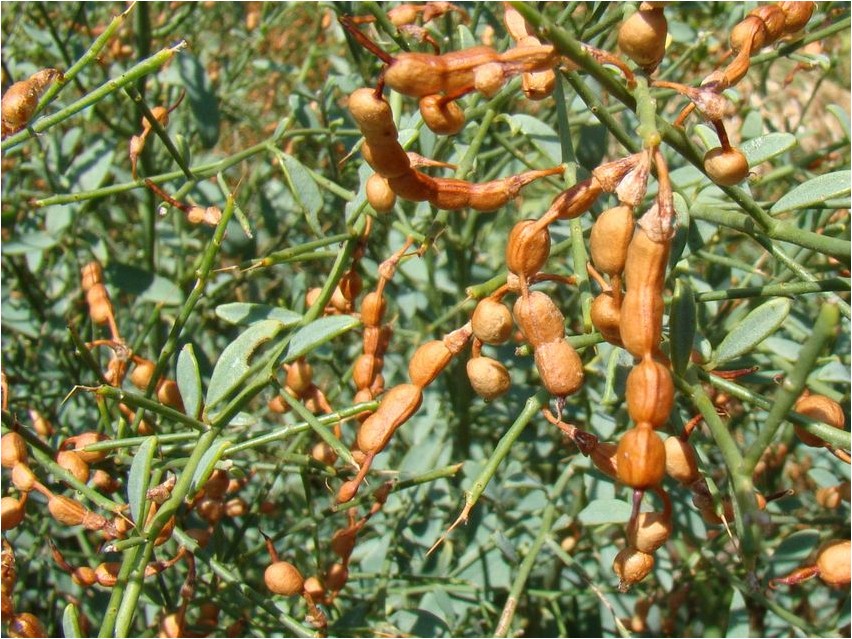
Camel thorn is part of the family called legumes; in Latin the name of this plant is: Alhagi pseudalhagi (Rich.) Fisch.
As for the name of the family itself, in Latin it sounds like this: Fabaceae Lindl.
Description of the common camel thorn
Common camel thorn is a perennial subshrub. The stems and branches of this plant are bare and furrowed and will be green in color. It is noteworthy that the branches of the common camel thorn are much thinner than the main stem; sometimes the branches are scatteredly hairy, and not just bare. The branches extend upward at a rather acute angle. The lower spines of the plant are very strong and short: they reach only one or two centimeters in length, the remaining spines are thin, and they reach about two to three centimeters in length, such spines are directed upward. The leaves of the common camel thorn are oblong, lanceolate or oval, these leaves are obtuse, they are equal in length to the spines or even slightly shorter. There are about three to eight flowers on one spine, the corolla will be red or pink in color, it is noteworthy that the sail itself is longer than the boat, and the bob can be either curved or straight.
Common camel thorn blooms during the period from May to August. The plant is found under natural conditions in the European part of Russia: namely in the Lower Don and Lower Volga regions, as well as in the Caucasus, Central Asia and Western Siberia: in the Verkhnetobolsky region. The plant prefers uncultivated areas in sand and irrigated areas.
Description of the medicinal properties of camel thorn

For medicinal purposes, it is recommended to use the roots of the plant, flowers, stems and leaves. The roots of the plant contain alkaloids, vitamin C, tannins and coumarins. As for the herb of the plant, it contains organic acids, rubber, essential oil, alkaloids, vitamin C, as well as flavonoids, tannins, carotene and catechins. The branches contain numerous nitrogen-containing compounds, as well as alkaloids and flavonoids.
A decoction prepared from the camel thorn herb is characterized by hemostatic, choleretic, astringent, diuretic, antipyretic and anti-inflammatory effects. A decoction and infusion prepared from the roots of the plant is recommended for use as a hemostatic agent, and is also quite effective in the treatment of hemorrhoids and dysentery. In addition, such drugs are also recommended for use in various liver diseases, hemorrhoids and dysentery. A decoction prepared from the camel thorn herb is recommended for use for gastritis, gastric ulcers, and this decoction also has the ability to reduce moisture loss in the body.
It is recommended to use the following mixture as a laxative: two teaspoons of crushed roots are taken in one glass of water, this mixture should be boiled for six to seven minutes, after which the decoction should be infused for thirty minutes, and then it is recommended to cool the decoction. This entire mixture should be drunk in the morning on an empty stomach.
The following decoction has a wide range of uses: to prepare such a decoction you will need to take four tablespoons of chopped herbs and half a liter of boiling water, after which you should leave the mixture to steep for one to two hours. This mixture should be strained. Using this mixture you can take baths for hemorrhoids, eczema, otitis, and also for washing wounds. In addition, this mixture is also good for douching in the treatment of cervical erosions.





