Cherimoya
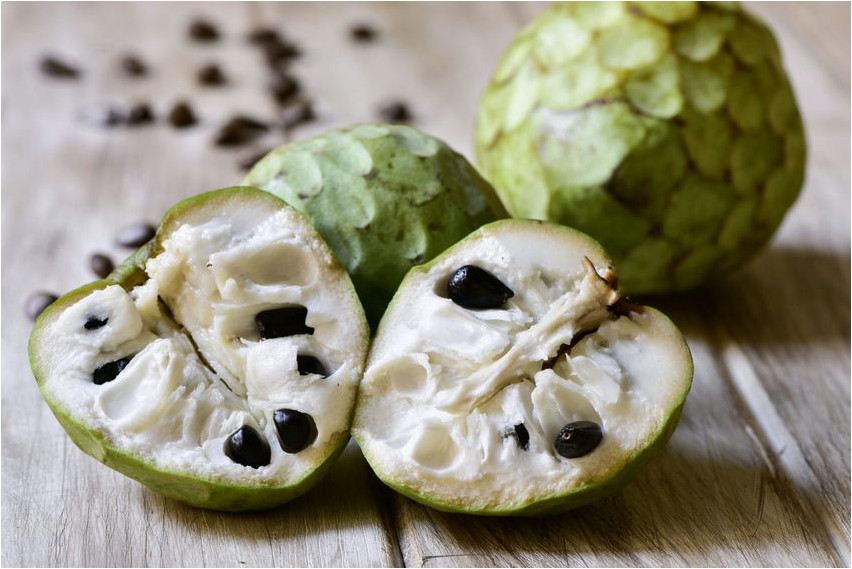
Cherimoya (lat. Annona cherimola) is a fruit tree with edible fruits belonging to the Annonaceae family.
Description
Cherimoya is a rather interesting tree, growing up to five to nine meters high and covered with two-row leaves four to nine centimeters wide and seven to fifteen centimeters long.
Cherimoya flowers are located on short stalks along the branches. All of them are formed by three rather fleshy outer petals and three slightly smaller inner petals.
Complex, clearly segmented fruits are characterized by a conical or heart-shaped shape and contain about two dozen shiny black seeds. The fibrous-creamy pulp of the fruit is white and has an extremely pleasant aroma. The weight of these fruits can vary from half a kilogram to three kilograms, with each fruit reaching ten centimeters in width and ten to twenty centimeters in length.
Cherimoya begins to bear fruit in the fourth or fifth year. By the way, the cherimoya tree is sometimes called the “ice cream tree.” It received such an interesting name because of the very unique appearance and taste of the fruit. In fact, if you freeze cherimoya, its taste and consistency will be very similar to ice cream. For this reason, the fruits are sometimes called “cream apples.”
Where does it grow
The Andean foothills of Colombia, Bolivia, Peru and Ecuador are considered the birthplace of cherimoya. By the way, in Peru this fruit was known back in the times of the Incas.

Now cherimoya is grown in Venezuela, Mexico, Chile, as well as in Argentina and Brazil. Thickets of this crop can also be found in cool areas of Central America, the Antilles, California and southern Florida. And outside the New World, cherimoya is grown in Eritrea, Somalia, South Africa, as well as in India, Australia and the Mediterranean. At the same time, the most substantial harvests are harvested in Portugal and Spain.
Application
Ripe cherimoya is most often eaten fresh. The correct way to eat it is to cut the fruits into two parts, and then extract the pulp from each part using a spoon. In addition, cherimoya is often added to salads, and soft drinks, sorbets and ice cream are also prepared with its addition. And the juice of ripe fruits is fermented for the subsequent preparation of alcoholic beverages.
As for cherimoya seeds, you cannot eat them, as they can cause irreparable harm to the digestive system.
Cherimoya has a fairly low calorie content — 100 g of this fruit contains only 74 kcal. In addition, it is characterized by high water content — every 100 grams of the pulp of these fruits contains approximately 79 grams of water. This fruit is an excellent solution for those who want to enjoy something sweet without gaining weight.
Crushed and lightly roasted cherimoya seeds are a very powerful emetic. And the powder from the seeds combined with fat is used to combat skin parasites and lice. In order to cope with lice, an alcohol solution is also prepared. Cherimoya also has a beneficial effect on the functioning of the stomach and liver and helps prevent the development of tumor processes. And to cope with food poisoning, dried cherimoya is ground into powder and two tablespoons of the resulting powder are consumed.
In South America, cherimoya leaves and bark are used to make a relaxing and soothing tea that helps improve digestion and has a mild laxative effect.
Hazardous properties
Under no circumstances should you eat poisonous cherimoya seeds. It is equally important to ensure that its juice does not get into the eyes — this can lead to blindness.
And diabetics need to consume cherimoya with extreme caution, as it is rich in carbohydrates and sugar. It is not recommended to eat these fruits if you have an individual intolerance.