Long-rayed volodushka
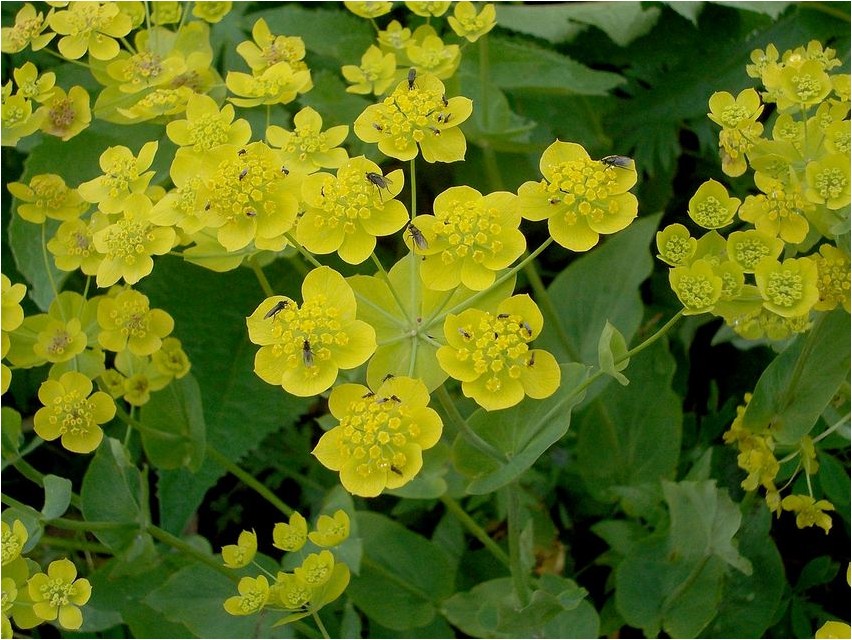
Bupleurum longiradiatum Turcz is one of the plants of the family called Umbelliferae.
As for the Latin name of the longbeam family, it will be: Apiaceae Lindl.
Description of the long-rayed volodushka
Long-beamed grass is a perennial herbaceous plant. There are several stems of this plant, they are simple and straight, and their height can vary between fifty and one hundred and eighty centimeters. The lowermost leaves of this plant are broad-linear, their length is approximately twenty to twenty-five centimeters, and their width does not exceed six millimeters. The middle and upper leaves of the long-rayed plant can be either linear-lanceolate or narrow-lanceolate. There is one single umbrella on each stem; it is worth noting that these umbrellas are quite large in size. Umbrellas are endowed with rather long rays: their length can even reach five centimeters. The involucres will consist of two unequal leaflets, while the involucres will consist of approximately five to six long elliptical leaflets, colored yellowish-green. The length of such leaflets of the long-rayed plant will be approximately one and a half centimeters, and their width can reach seven millimeters. The flowers are approximately ten to fifteen in an umbel, the pedicels are quite short and will not exceed three millimeters, while the pedicels will also be slightly unequal. The petals of this plant are painted in light yellow tones.
Flowering of the long-beamed grass occurs in the period from July to August. For growth, this plant prefers the territory of the Far East and Eastern Siberia.
Description of the medicinal properties of long-beamed volosum
This plant is endowed with very valuable medicinal properties, and for this purpose it is recommended to use the fruits and roots of the long-rayed plant.
The roots of this plant contain coumarins, polyacetylene compounds, saicosaponins, tikusaikoside, alpha-spinasterol, stigmasterol, saicosides, rutin and isoquercitrin. Coumarins were found in the grass of the long-beamed grass, and in the stems and flowers there was a rather impressive content of rutin, isorhamnetin, trirutinoside, quercetin, isorhamnetin and isoquecitrin. In addition, fruits and seeds contain coumarins, as well as fatty oil, which in turn contains petroselinic acid. At the same time, coumarins and the following flavonoids were also found in the leaves of this plant: rutin, quercetin, isorhamnetin, isorhamnetin trirutinoside and isoquercitrin.

Chinese medicine recommends the use of a decoction prepared from the roots of the long-rayed plant for headaches, various gastrointestinal diseases, dizziness and women’s diseases. In addition, this decoction can also be used as an antipyretic. It is noteworthy that the roots and fruits of this plant are endowed with antimalarial and antitumor properties.
For various colds, as well as for malaria, muscle pain, headaches and infectious inflammation of the upper respiratory tract, the following remedy is recommended: to prepare it, take eight grams of crushed roots per three hundred milliliters of boiling water. The resulting mixture should be boiled over fairly low heat for five to six minutes, then left to infuse for an hour, and then strained thoroughly. This remedy should be taken about half a glass three times a day before meals.
Golden volodushka is salvation under your feet.
https://www. youtube. com/watch? v=8EWk4ECZ5Q8





