Mistletoe
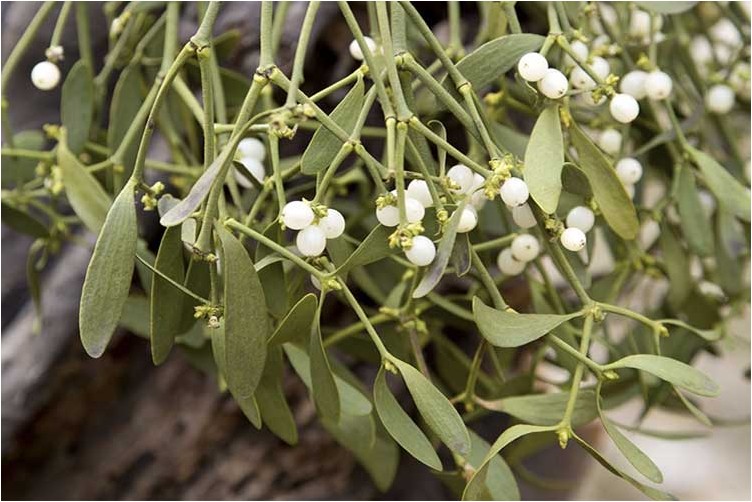
Mistletoe is one of the plants of the family called Beltaceae; in Latin the name of this plant will be as follows: Viscum album L.
As for the name of the mistletoe family itself, in Latin it will be: Loranthaceae Juss.
Description of mistletoe
Mistletoe is known by numerous popular names: oak berries, army grass, whirlwind nest, willow mistletoe, shulga, bird glue and ever-flowering grass. Mistletoe is an evergreen dioecious shrub that will be globular in shape and fork-branched. Such a shrub settles on the branches of various deciduous trees, and its height will fluctuate between twenty and fifty centimeters. With the branching of its roots, this plant will penetrate under the bark and into the wood of such trees, forming quite numerous suckers. The branches of mistletoe are green in color, or they may have a brown-green color at the very bottom. The leaves of this plant are sessile, thick-skinned, opposite and entire, they are endowed with very noticeable longitudinal veins. The staminate flowers of white mistletoe are quite large, while the pistillate flowers are only about two millimeters long. The fruit of this plant is a false single-seeded and spherical berry, the diameter of which is equal to one centimeter. When unripe, this berry is colored green, and when ripe it turns white. The mistletoe seed will be quite large, heart-shaped or oval-heart-shaped, about eight millimeters in diameter. Such a seed is covered with sticky and slimy pulp, and it is colored grayish-white.
This plant blooms from March to April, while the berries will ripen from about May to June. Under natural conditions, this plant is found in the Crimea, Belarus, Ukraine, the southwestern and central zone of the European part of Russia.
Description of the medicinal properties of white mistletoe
Mistletoe possesses valuable medicinal properties, with its leaves, berries, and young branches used for medicinal purposes. It is recommended to harvest these raw materials between September and October. These valuable medicinal properties are attributed to the plant’s content of viscerin, a white amorphous substance called viscotoxin, beta-viscol, choline, amines, fatty acids, acetylcholine, prothioninecholine, oleic and ursolic acids, as well as alkaloid-like and resinous substances. Mistletoe leaves, in turn, contain ascorbic acid and carotene, while the sticky pulp of the fruit contains rubber. It should be noted that this plant is poisonous. An infusion made from the branches, berries, and leaves of this plant has the ability to calm the nervous system, improve intestinal function, stop bleeding, and also promote milk supply in nursing mothers. It relieves headaches, and suppresses epileptic seizures and convulsions. Furthermore, this mistletoe infusion is recommended for atherosclerosis, uterine bleeding, whooping cough, hyperthyroidism, epileptic seizures, and malignant tumors.
Decoctions of mistletoe leaves are also used externally as poultices for ulcers, suppurations, persistent wounds, furunculosis, gout, rheumatism, and many skin diseases. Fresh juice from this plant is indicated for rectal prolapse and dysentery. The leaves and fruits of mistletoe are applied externally for tumors and inflammation of the lymph nodes. Mistletoe Medicinal Properties

Mistletoe





