Broadleaf cotton grass
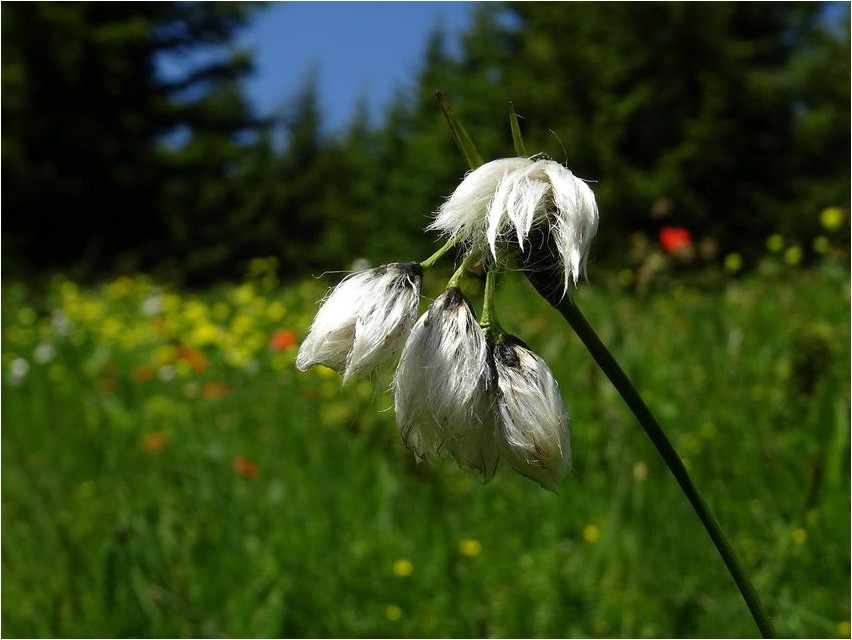
Broadleaf cotton grass is one of the plants of the family called sedges; in Latin the name of this plant will be as follows: Eriophorum latifolium Hoppe.
As for the name of the broadleaf cotton grass family itself, in Latin it will be: Cyperaceae Juss.
Description of broadleaf cotton grass
Broadleaf cotton grass is known by numerous popular names: popki, whitehead, whitehead, whitehead, swampweed, fluffy wheatgrass, fluff, flax, swamp flax, spiked wheatgrass, downy wheatgrass, downy wheatgrass and pufflina. Broadleaf cotton grass is a perennial herbaceous plant whose height will vary between thirty and sixty centimeters. At the same time, this plant will form turf. The leaves of this plant will be narrow-lanceolate, linear, flat, more or less triangular, rough along the edges, and pointed at the apex. The sheath of the lower leaves of broadleaf cotton grass is colored in black-brown tones and is reticulate-fibrous. The spikelets of this plant will be crowded at the very tops with rough stalks. The flowers of broadleaf cotton grass are bisexual; the perianth will consist of quite numerous bristles, which will form a fluffy brush after the end of the flowering period. There are only three stamens of broadleaf cotton grass, and the pistil, in turn, will be endowed with three stigmas. The fruits of this plant will be triangular and flattened, and the achenes are endowed with a fluffy tuft.
Broadleaf cotton grass blooms in May. Under natural conditions, this plant is found in the Far East, the Caucasus, Belarus, Ukraine, the European part of Russia, Western and Eastern Siberia. For growth, this plant prefers the banks of water bodies, marshy meadows, marshy wetlands and swamps.
Description of the medicinal properties of broadleaf cotton grass
Broadleaf cotton grass is endowed with very valuable healing properties, and it is recommended to use the grass of this plant for medicinal purposes. The term grass includes leaves, flowers and stems. It is recommended to harvest such medicinal raw materials throughout the entire period of fruit ripening: at that moment, fouling with tufts will occur.
As for traditional medicine, here this plant is very widespread. Traditional medicine recommends using an aqueous infusion prepared from the broadleaf cotton grass herb as a laxative and diuretic. It is noteworthy that tea based on the fluffy spikelets of this plant is endowed with very effective expectorant, diaphoretic and hemostatic properties.

In addition, a decoction based on cotton grass is used to treat colds; this decoction is also drunk and poured over the body, and the smoke from burning the grass of this plant should be fumigated for myositis.
For constipation, it is recommended to use the following very effective medicinal remedy based on this plant: to prepare such a medicinal remedy, you will need to take about one tablespoon of crushed dry grass of broadleaf cotton grass per glass of boiling water. The resulting medicinal mixture should first be left to infuse for approximately one hour in a tightly sealed container, and then this mixture based on this plant should be filtered very carefully. Take the resulting medicine based on cotton grass three to four times a day before meals, one to two tablespoons. If used correctly, such a remedy based on this plant will be very effective.





