Gentian yellow
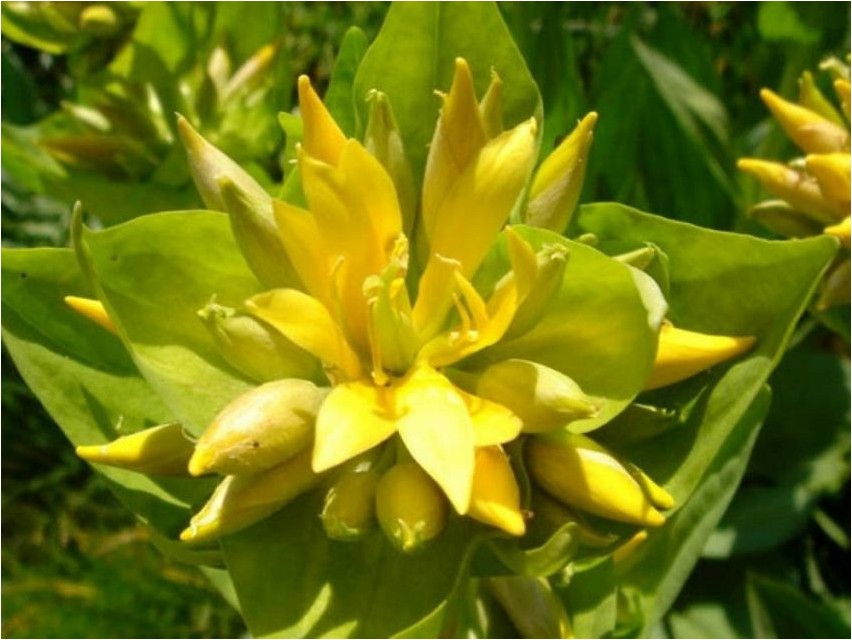
Yellow gentian is one of the plants of the family called Gentianaceae; in Latin the name of this plant will be as follows: Gentiana lutea L.
As for the name of the yellow gentian family itself, in Latin it will be: Gentianaceae Juss.
Description of Gentian yellow
Yellow gentian is a perennial herbaceous plant whose height can exceed one meter. This plant is endowed with a thick but short multi-headed rhizome; on such a rhizome ring-shaped traces of dead leaves will be visible. It is noteworthy that the rhizome of this plant will gradually turn into a root. The stem of Gentian yellow will be erect, bare and cylindrical. The leaves are opposite, they will grow together at their bases in pairs, and will also be stem-encompassing. In addition, such leaves will be simple, entire-edged, broadly ovate, and they are also endowed with highly prominent five to seven veins. The length of the leaves of this plant can reach thirty centimeters, and the width will be fifteen centimeters. The flowers of Gentian yellow are quite large, they are yellow in color, and are also collected in bunches in the very axils of the stem leaves. There are about six stamens, but only one pistil. The fruit of this plant is an elongated multi-seeded bivalve capsule. Gentian yellow seeds are flat, dark brown and winged.
This plant blooms from July to August. Fruit ripening will begin around September-October. It should be noted that this plant is quite rare and can be found exclusively in the highlands of the Carpathians, and is also cultivated in the Leningrad region. The plant will grow either in groups or individual specimens in the Transcarpathian and Ivano-Frankivsk regions, and very rarely yellow gentian can be found in the Chernihiv and Lviv regions. For growth, this plant prefers the heights of subalpine meadows, forest glades of mountain forests, young sparse pine forests, and the plant can also be found among mountain shrubs of mountain pine, green alder, blueberries, blueberries and Siberian juniper.
Description of the medicinal properties of yellow gentian
Yellow gentian is endowed with quite valuable healing properties, and it is recommended to use the roots and rhizomes of this plant for medicinal purposes. Such parts should be harvested either in the autumn or early spring.
The roots and rhizomes of yellow gentian contain sucrose, gentarisin and the bitter glycoside gentiopicrin, which over time, during long-term storage, will turn into gentiomarin. In addition, it also contains pectin substances, mucus, resin and a special trisaccharide, which will be broken down into two parts glucose and one part fructose.

It should be noted that all the bitter substances of this plant, and especially gentiopicrin, are capable of increasing the excitability of the food center to various taste stimuli, and will also enhance the secretory and motor function of the gastrointestinal tract. In addition, large doses of this plant will have a rather depressing effect on stomach function.
It is noteworthy that a decoction of the rhizomes and roots of this plant will stimulate the appetite, as well as improve digestion and bile secretion, and in addition, it can also eliminate persistent heartburn. In addition, such products also have antiseptic and anthelmintic properties.
As for traditional medicine, a decoction prepared from the roots and rhizomes of this plant is used for constipation, persistent heartburn, lack of appetite, pulmonary tuberculosis, rheumatism, gout and arthritis of various origins.
Gentian yellow
https://www. youtube. com/watch? v=w1J8_fNIGB4