Angelica evasata
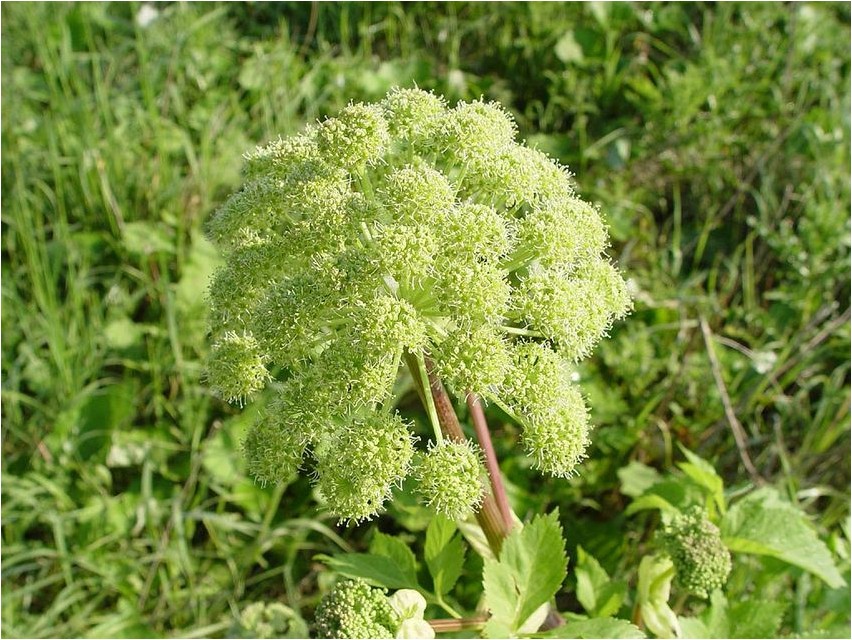
Angelica evasata is a member of the Apiaceae family. Its Latin name is Angelica anomala Ave-Lall.
The Latin name for the Angelica evasata family is Apiaceae Lindl.
Description of Angelica evasata
Angelica evasata is a perennial herbaceous plant with a straight rootstock that grows 40 to 50 centimeters tall. The stem is hollow, rounded, and finely ribbed, branching at the top and sparsely velvety at the base. The upper internodes are densely pubescent. The basal and lower stem leaves are bipinnate and long-petiolate, with oblong, short-pubescent sheaths. It’s noteworthy that the upper leaves of Angelica evasiva are smaller, divided into linear lobes, and sit on a slightly deviated cylindrical sheath. The inflorescences of this plant are collected in umbels with twenty to thirty rough-pubescent rays. The involucre is absent, and the rays of the umbel are naked, with umbels measuring about one centimeter in diameter. The leaflets of the involucre of Angelica evasiva are subulate-linear, with only two to five leaves. They fall off quite early, and sometimes may be completely absent. The petals of this plant are white, and the fruits are winged and ovoid.
Angelica evasiva blooms in July. In the wild, this plant can be found in the south of Primorye and Eastern Siberia. As for its general distribution, it can be found in China and Mongolia. Description of the medicinal properties of angelica evasives
Angelica evasives has very valuable medicinal properties, and its roots, shoots, and seeds are recommended for medicinal purposes. Angelica evasives roots contain coumarin compounds, as well as an essential oil containing phellandrene. The fruits, umbels, and leaves of angelica evasives contain essential oil.
Traditional medicine uses the roots, shoots and seeds of this plant. Such remedies are used for numerous gynecological diseases, and they also help regulate the menstrual cycle and are used for nasal, uterine and hemorrhoidal bleeding. In addition, such drugs can be used as antispasmodics for dysmenorrhea.
Preparations based on this plant are used as an analgesic for toothache, renal colic, hemorrhoids, and is also used as a diaphoretic for various colds, flu, inflammation of the nasopharynx and dizziness.

It is noteworthy that the therapeutic activity of the roots of this plant as a mother herb has been confirmed in clinical studies. Externally, a concentrated decoction of the roots of angelica is used for carbuncles and burns.
For hemorrhoids, it is recommended to use the following remedy based on this plant: to prepare such a remedy, you will need to take six grams of roots per glass of water. The resulting product should be boiled for six to seven minutes, and then infused for one or two hours, then the product is filtered very carefully. Take the resulting product one or two tablespoons three to four times a day before meals. To achieve the greatest effectiveness when taking this product, it is recommended to strictly follow all the rules of preparation and administration.
Funeral of a great country or the end of freedom





