Bearberry
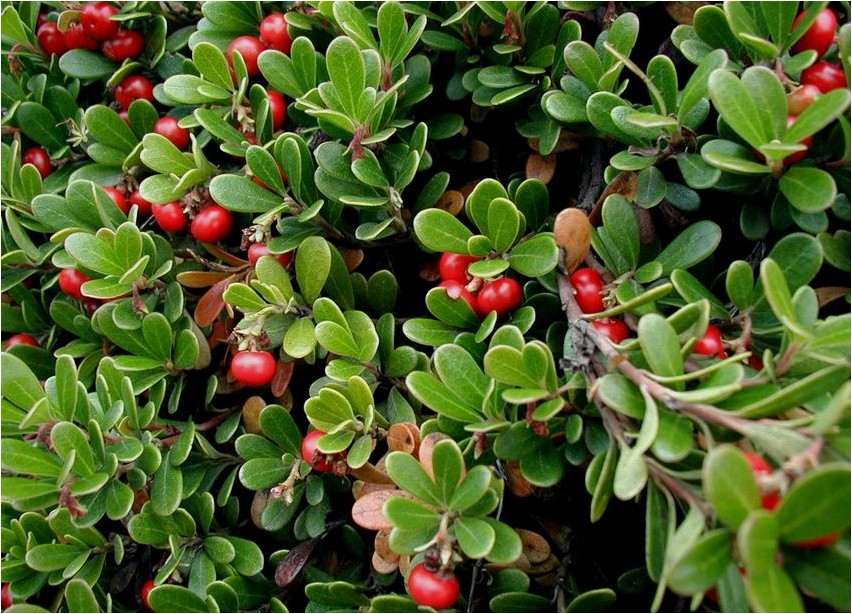
Bearberry (lat. Arctostaphylos) is a genus of low-growing and creeping evergreen subshrubs and shrubs of the Ericaceae family.
Bearberry is widespread throughout Russia, North America and the Caucasus. Typical habitats are burnt areas, clearings, rocky screes, coastal dunes, deciduous and pine forests.
Characteristics of culture
Bearberry is a perennial, highly branched plant up to 30 cm high with recumbent, ascending and easily rooted stems. The leaves are leathery, entire, dark green with a shine, obovate, oblong, rounded, and sit alternately on short petioles. A network of depressed veins is noticeable on the upper side of the leaves.
The flowers are small, drooping, white-pink, collected in short apical racemes. The corolla is pitcher-shaped, covered with hard hairs on the inside. The fruit is a coenocarpous drupe, berry-shaped, bright red in color, 6-8 mm in diameter, containing 5 seeds. Bearberry blooms in May-June, the fruits ripen in August-September.
Growing conditions
Bearberry actively develops in lightly shaded or intensely lit areas with well-drained and acidic soils. Bearberry is a weak competitor, so it is not recommended to plant other crops in close proximity that could suppress the plant. Bearberry does not accept heavy loamy and clayey soils; it also has a negative attitude towards waterlogging and stagnation of water.
Reproduction and planting
Bearberry is propagated by seeds and cuttings. Experienced gardeners consider the seed method inappropriate, despite the fact that the seeds of the crop have high viability. Sow seeds in autumn in seedling boxes under plastic film or glass. Young plants are planted in the ground next spring. Cuttings are a more common method. Rooting rate is 90%. Cuttings are planted in early spring in greenhouses with a substrate consisting of peat and sand, taken in a ratio of 2:1 or 1:1. High-quality drainage is considered a prerequisite.

The seedlings are planted in their permanent location the following year. I prepare the site for the planting in advance: I dig up the soil and add high-moor peat and fallen pine needles in a ratio of 5:2 or 5:1. A small amount of sand is also recommended. The seedlings are planted in furrows 15-20 cm deep, the voids are filled, and the plants are watered thoroughly. The distance between plants should be at least 25 cm. No mineral fertilizers are needed at planting. Bearberry grown from cuttings blooms 5-8 years after planting.
Care
The plant is undemanding in terms of soil fertility, so frequent fertilizing is not necessary. Superphosphate can be added occasionally at a rate of 5 g per square meter. Water the bearberry infrequently, only during prolonged droughts. After watering, it is recommended to mulch the soil with pine needles, sand, gravel, or crushed bark. Natural mulch is best, as it acidifies the soil.
Loosening the root zone, removing weeds, and thinning are equally important care procedures for bearberry. It is important to remember that weeds can overwhelm the plant. Under favorable growing conditions, bearberry grows quickly and occupies large areas, and to prevent this, measures must be taken promptly.
Uses
Bearberry is a plant with a wide range of uses. It is used in cooking, folk medicine, and industrially for dyeing woolen materials and tanning leather. For medicinal purposes, the plant’s leaves are harvested in the spring before flowering or in the fall after the fruits have fully ripened. Bearberry-based preparations are used to treat purulent wounds, ulcers, urolithiasis, chronic nephritis, neuroses, and other conditions.