Carambola
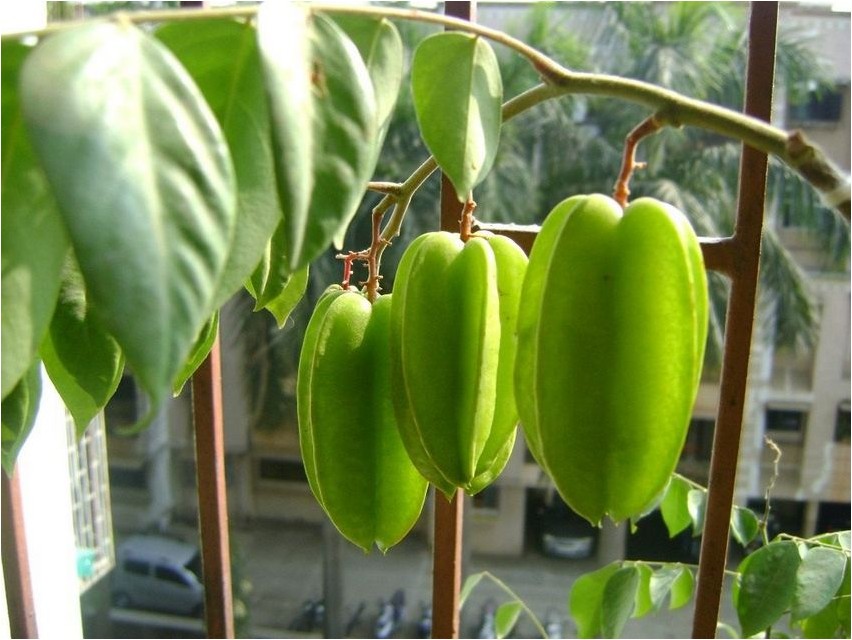
Carambola (lat. Averrhoa carambola) is an evergreen tree belonging to the Oxalis family. The fruits of this plant are often called “starfruits” or “tropical stars”.
Description
Carambola is a tree endowed with acacia-like compound leaves, the length of which can reach half a meter, and fancy pinkish flowers. Each tree has a very dense crown and often grows up to five meters high.
The glossy carambola fruits are colored either yellowish-brown or yellowish-greenish, or rich yellow. They are characterized by pronounced ribbing; in addition, in cross section, each fruit forms an elegant five-pointed star. These juicy and crispy fruits with pronounced ribbed growths can be either sweet and sour or sweet. Their taste is a cross between cucumber, gooseberry and apple. Carambola is also an excellent source of vitamin C. As a rule, the fruits begin to ripen in May and end around August.
Where does it grow
Most often you can see carambola in Indonesia, India or Sri Lanka. Also nowadays it is successfully cultivated in Southeast and South Asia. And recently, this unusual tree has been acclimatized in Israel, the USA (especially in the states of Hawaii and Florida), French Polynesia, as well as in Guiana, Ghana and Brazil.
Application
Carambola is used mainly to decorate desserts or cocktails. It perfectly helps quench thirst, since these wonderful fruits contain a lot of liquid.
One of the main advantages of carambola is its extremely low calorie content (34 — 35 kcal for every 100 g). In addition, these “star” fruits are rich in all kinds of microelements, as well as riboflavin, thiamine, vitamin C, pantothenic acid and beta-carotene. It is difficult to find a more suitable source of minerals and vitamins.

Thiamine in carambola helps maintain normal functioning of the nervous system, and riboflavin takes an active part in the formation of antibodies and red blood cells. It also helps regulate the functioning of the thyroid gland, reproductive functions and has a beneficial effect on the condition of nails, hair and skin. Pantothenic acid contained in carambola helps regulate the metabolism of carbohydrates and fats and is an excellent prevention of allergies, colitis, heart disease and arthritis.
In Asian countries, carambola is widely used for vitamin deficiency, weakened immunity, constipation, colic, fever and headaches. And in Sri Lanka, the acid contained in these bizarre fruits is successfully used to remove stains from fabrics. Moreover, carambola helps polish brass or copper products!
Contraindications
Carambola is not advisable for people suffering from stomach and duodenal ulcers, as well as gastritis or enterocolitis (especially in the acute stage) — it contains a lot of oxalic acid.
You should also not overuse carambola, as this can provoke a sharp disturbance in salt metabolism or lead to the development of kidney pathology.
Growing and care
Carambola differs favorably from most other tropical crops in that it does not require a lot of light. This plant is moisture-loving and grows very well even at home. It is not difficult to grow carambola even from a single seed, however, at home it most often grows in a weeping form.
Carambola is quite unpretentious in care. In addition, it is very shade-tolerant and is not at all afraid of cold winter drafts. And this plant requires moderate watering — carambola cannot be called drought-resistant.