Lungwort obscure
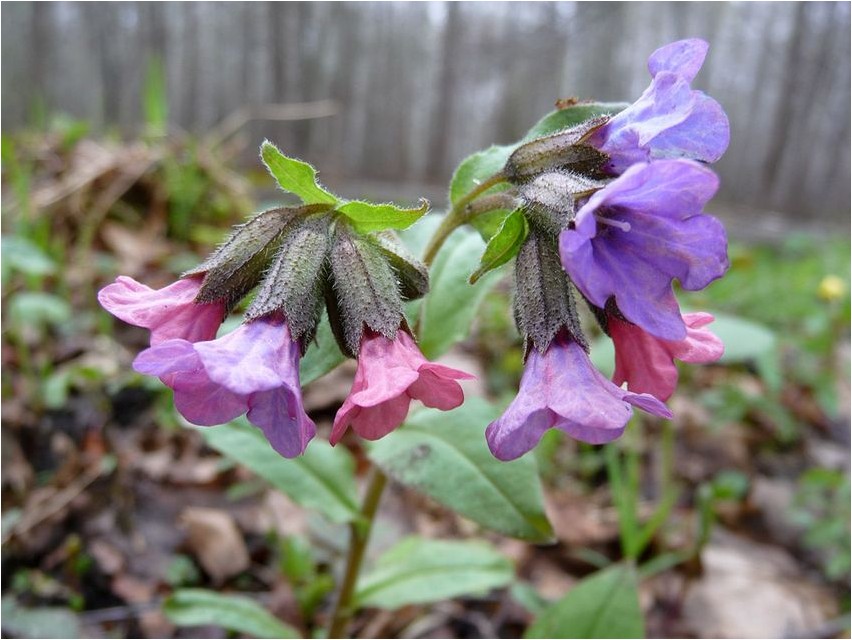
Lungwort is a member of the borage family; in Latin the name of this plant would be Pulmonaria obscura Dumort.
As for the name of the lungwort family itself, in Latin it will be like this: Boraginaceae Juss.
Description of lungwort
Lungwort is a perennial herbaceous plant whose height will vary between ten and forty centimeters. The basal leaves of this plant can be either cordate-ovate or ovate-lanceolate, and in addition they are bristly and pointed, and they will suddenly taper into a rather long, narrow-winged petiole. The lower leaves of the flowering shoots of lungwort are sharp, slightly decurrent and oblong. The diameter of the corolla of this plant is about seven to ten millimeters; at first, such a corolla will be colored pink, and then acquire either a blue or blue-violet color. The length of the fruit cups will be about ten to fifteen millimeters, they will be narrowly bell-shaped.
Lungwort indistinct blooms in the spring. Under natural conditions, this plant is found in the European part of Russia, Moldova, Ukraine and Belarus. For growth, this plant prefers coniferous-deciduous forests and places among shrubs, while it is found mainly on sandy soil. It should be noted that the lungwort is a very ornamental plant.
Description of the medicinal properties of lungwort
Lungwort is endowed with very valuable healing properties, and it is recommended to use the herb of this plant for medicinal purposes. The concept of grass includes the flowers, leaves and stems of this plant.
The presence of such valuable healing properties should be explained by the content of phenol carbonic acids, caffeic and lithospermic, in the rhizomes of this plant, while the herb will contain tannins, rutin, carotene and vitamin C. The leaves and flowers of this plant also contain vitamin C.

It is noteworthy that the experiment proved that a lyophilized aqueous extract of this plant in a ratio of one to ten will have a muscle relaxant and contraceptive effect, while suppressing the motility of the uterine horns.
Infusion and decoction prepared from the herb of this plant are recommended for use for bronchopneumonia, acute respiratory diseases, numerous women’s diseases and lung diseases, diseases of the gastrointestinal tract, anemia, hemorrhoids, kidney and liver diseases. As for external use, lungwort is used for eczema and scrofula, as well as as a wound-healing and hemostatic agent.
It should be noted that the leaves of this plant are recommended for use in salads.
For colds, it is recommended to use the following very effective remedy based on this plant: to prepare such a healing remedy, you will need to take two tablespoons of dry crushed lungwort herb into two glasses of boiling water. The resulting healing mixture should be infused for about one hour, after which it is recommended to strain this mixture very carefully. Take the resulting healing remedy based on lungwort three to four times a day throughout the day, one-third of a glass. To achieve maximum effect, it is important to strictly follow all the rules of administration, as well as the preparation of such a remedy based on lungwort.