Ailant
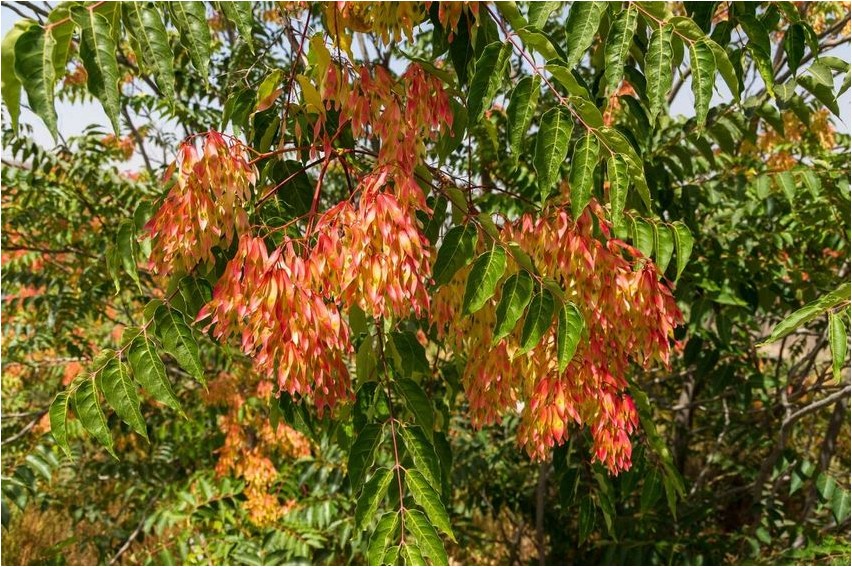
Ailanthus (lat. Ailanthus) is a genus of deciduous trees of the Simarubaceae family. Representatives of the genus are found in Southern and Eastern Europe, Asia and Australia.
Characteristics of culture
Ailanthus is a fast-growing deciduous tree with an ovoid crown and a trunk covered with gray-brown furrowed bark. The leaves are compound, imparipinnate, consist of 13-40 leaflets, arranged alternately. When blooming, the leaves emit a not very pleasant smell. The flowers are small, five- or six-petalled, unisexual, collected in paniculate inflorescences. The fruits are prefabricated and consist of 1-6 oblong-shaped lionfish. The seeds are located one at a time in the middle of the lionfish.
Common types
*Ailanthus altissima, or Chinese ash (lat. Ailanthus altissima) – the species is represented by trees whose height varies from 10 to 25 m. The trunk is slender, cylindrical. The crown of young trees is broadly pyramidal, while that of adults is tent-shaped and spreading. The leaves are compound, palm-shaped, quite large, up to 60-70 cm long, consist of 13-25 ovate-lanceolate leaflets, and have an unpleasant odor. The flowers are small, bisexual and male, yellowish-green, collected in large paniculate inflorescences. The tallest ailanthus is distinguished by its rapid growth; in 5 years the plants reach a height of 4-6 m. It is a sun-loving species, unpretentious to soil conditions, and can develop without problems on sandy and gravelly, rocky and even saline soils. It has a more decorative appearance when grown on moist, deep, loamy soils. It is drought-resistant, but cannot boast of frost-resistant properties; it cannot tolerate temperatures belo w-20 C. At a temperature o f-25C, the shoots freeze severely, but with the onset of heat they quickly recover.
*Common ailanthus (lat. Ailanthus excelsa) – the species is represented by trees up to 25 m high with a strong branched trunk covered with grayish-brown bark. The leaves are twisted, up to 30 cm long, equipped with coarse veins. The flowers are small, green, collected panicles. Ailanthus trifolium is propagated mainly by seeds.
*Ailanthus triphylla (lat. Ailanthus triphylla) – the species is represented by tall trees up to 30 m high with a slender, strong trunk. The leaves are sickle-shaped, opposite, up to 12 cm long, the underside is pubescent. The flowers are small, greenish, just like other representatives of the genus, collected in paniculate inflorescences.
Reproduction Ailanthus is propagated by seeds, root suckers and grafting. The seeds remain viable for 1. 5-2 years; they are stored in paper bags or burlap in a dry, well-ventilated area. Germination is average, reaches 50%. Before sowing, the seeds are pre-treated: they are soaked in warm water for 24-36 hours. Ailanthus is sown in early spring or autumn. The embedment depth is 2-3 cm.

The seed method is quite lengthy and painstaking; you cannot be sure that most of the seeds will sprout. You should also not hope for strong and healthy trees, because seedlings need careful care. Ailanthus shoots appear in 3-4 weeks. It’s hard to imagine, but under optimal conditions, plants can grow up to 3 m.
The soil for the crop is prepared in advance: it is carefully dug up, removing weeds, rotted manure, mineral fertilizers and wood ash are added. It should be remembered that ailanthus has a negative attitude towards transplantation; it does not adapt well to new soil and completely different lighting, therefore, when planting seedlings and saplings, this fact must be taken into account.
Care
Water ailanthus moderately and regularly. It is recommended to use only warm water for irrigation. The use of cold water can have a detrimental effect on the development of the crop. Once every six months the tree trunk area is dug. Ailanthus has a positive attitude towards fertilizing. The first feeding is carried out in the spring during the snow melt, using organic matter and mineral fertilizers, the second – in the summer or late autumn. Mulching the tree trunk area for the winter is mandatory. Tree trunks should also be protected from rodent attacks.
Application
Ailant is used for landscaping personal plots, alleys and city parks. They look harmonious both in a single copy and in groups. Ailanthus wood is used for making paper and various carpentry products. Flowers, fruits and young shoots are used in folk medicine. The bark of some species is used to get rid of worms and some intestinal diseases.