Panax ginseng
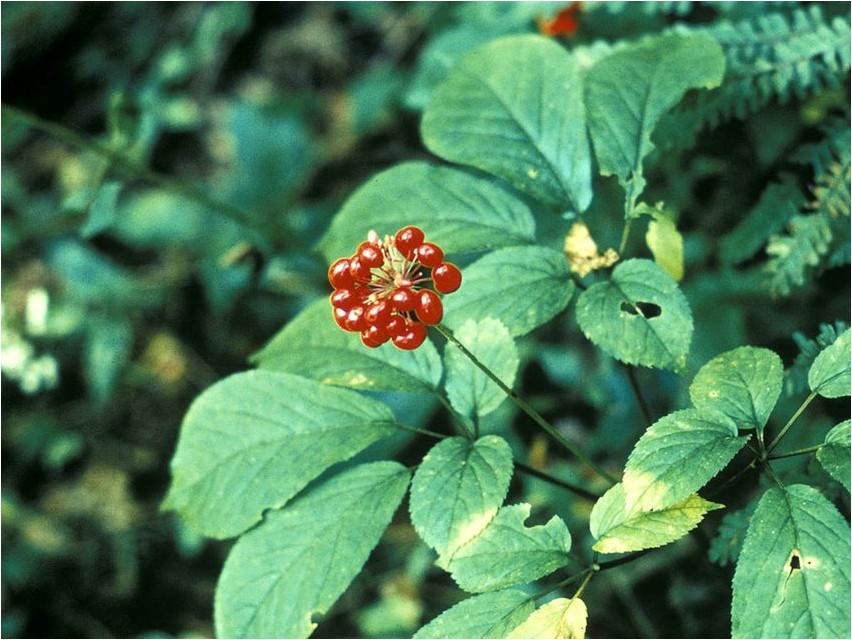
Common ginseng is one of the plants of the family called Araliaceae; in Latin the name of this plant will be as follows: Rapach ginseng.
As for the name of the common ginseng family itself, in Latin it will be like this: Araliaceae Juss.
Description of Panax Ginseng
Panax ginseng is also known as human root. Common ginseng is a perennial herbaceous plant whose height is thirty to eighty centimeters. The lifespan of such a plant reaches one hundred years; it is endowed with a rather long rhizome and a thickened main root. Such a main root is very reminiscent of a human figure, the root is painted in grayish-yellow tones, and its shape will be cylindrical-oblong. In diameter, this root reaches two to three centimeters, and the length is twenty to twenty-five centimeters; at the end of such a stem there will be from two to six branches. There are ring wrinkles in the upper part, and their number will increase as the plant matures.
So-called adventitious roots extend from the main rhizome; it is noteworthy that they can be quite thick. A wintering bud will develop at the top of the rhizome, and the future above-ground shoot will be formed in it. Leaves, two or three at a time, are collected at the very top of the stem into a leaflet. The leaves of Panax ginseng are long-petiolate, and right down to the base they will be palmately compound and palmately lobed. The stems and petioles of the leaves of this plant are painted in purple-reddish tones.
A flowering stem emerges from the leaflet, the length of which reaches about twenty-five centimeters. Such a stem will be endowed with one simple apical umbel; below such an umbel, smaller umbels are formed on rather large branches.
Common ginseng blooms in July, and fruit ripening begins in August and ends in September. Under natural conditions, the plant is found in the Primorsky Territory of Russia, on the Korean Peninsula and in China. This plant is cultivated in the Caucasus and Ukraine, Siberia, Japan and the Primorsky Territory of Russia. It is noteworthy that in Korea and China the plant has been cultivated for more than one century.

Description of the medicinal properties of ordinary ginseng
Panax ginseng possesses highly valuable medicinal properties, and its rhizomes, roots, fruit juice, and leaves are recommended for medicinal purposes. It is believed that the plant can combat all diseases associated with old age, and also promotes vitality and relieves fatigue and exhaustion.
It’s worth noting that in China, this plant was literally worth its weight in gold. As early as three thousand years BC, it was considered a cure for virtually all ailments in Chinese medicine. It was believed to have stimulating, strengthening, and general tonic effects. The plant was also considered beneficial in old age, as well as for exhaustion, impotence, hypochondria, and various depressive states.
Preparations based on this plant can increase gas exchange, stimulate tissue respiration, and accelerate the healing of wounds and ulcers. A tincture of Panax ginseng will increase bile secretion and enhance the light sensitivity of the human eye during the process of dark adaptation. Taking preparations based on this plant improves appetite, sleep, and mood.
To prepare a remedy based on this plant, soak 40 grams of root in cold water for three to four hours. Then, chop the root, place it in 500 milliliters of strong alcohol, and let it steep for twenty days.





