Norway spruce
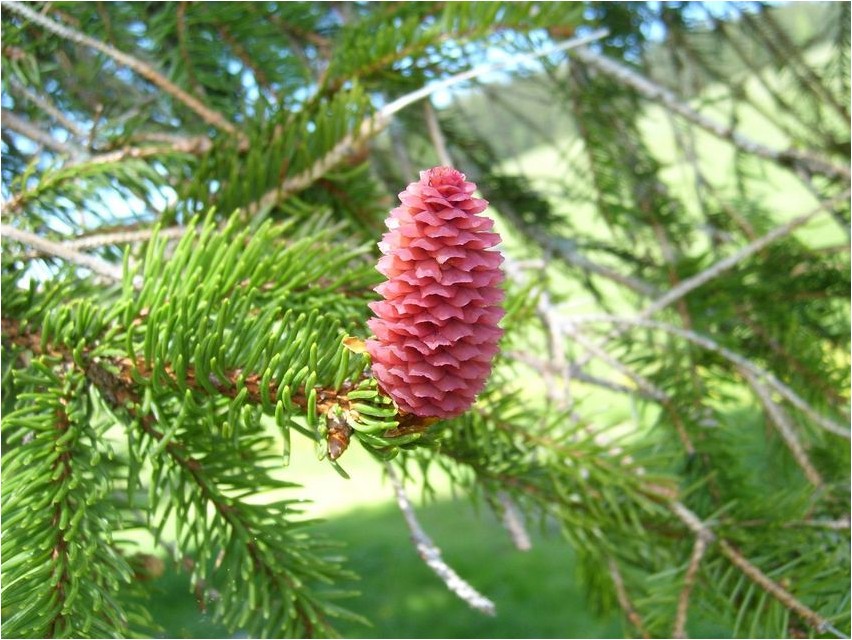
Norway spruce is one of the plants of the family called pine; in Latin the name of this plant will be as follows: Picea abies L.
As for the name of the common spruce family itself, in Latin it will be: Pinaceae Lindl.
Description of Norway spruce
Norway spruce is an evergreen tree with a cone-shaped crown and flaky bark, colored brownish-gray. It is noteworthy that the common spruce can be called the most ancient tree in the Russian forest. The origin of this plant dates back to the Cretaceous period of the Mesozoic era. Conifer needles are single, they are flattened-tetrahedral, densely spirally arranged and pointed. Conifer needles are painted in dark green tones.
The male stamens of the cones will be elongated and cylindrical, they are colored purple, and as they ripen they turn green. Mature cones are brown. The seed scales are notched-toothed and convex, they are endowed with long wings. Pollination of cones occurs during the period from May to June, while the ripening of cones occurs in October.
Under natural conditions, Norway spruce can be found in Ukraine, Belarus and Russia. For growth, the plant prefers pure and mixed forests. The plant is used for landscaping, as well as for creating railway snow protection plantings.
Description of the medicinal properties of Norway spruce
Norway spruce is endowed with very valuable healing properties, and young tops of branches with buds, needles and immature seed cones should be used for medicinal purposes. The sap of the tree, which is obtained by various methods of cutting, is also valuable. This juice is called oleoresin, from which turpentine can be obtained by steam distillation. This turpentine is used both in medicine and in industry.

Norway spruce needles contain an essential oil, which in its chemical composition will be very similar to the essential oil of pine. Carotene, ascorbic acid, chlorophyll, minerals and tannins, phytoncides and resin were also found in the needles. The cones contain resin and tannins.
Norway spruce needles are endowed with antimicrobial, diaphoretic, analgesic, anti-inflammatory, diuretic, choleretic and antiscorbutic effects. Due to the presence of carotene, chlorophyll and a large amount of ascorbic acid in the composition of this plant, common spruce can regulate metabolism and improve hematopoiesis.
In scientific medicine, the cones of this plant are quite widely used. An infusion prepared from common spruce cones is recommended for use in the form of rinses and inhalations for chronic tonsillitis, laryngitis, pharyngitis, sore throat, pneumonia, chronic bronchitis, bronchiectasis and bronchial asthma. This infusion can also be used to prevent various childhood diseases.
To prepare an infusion based on common spruce, you will need to take one part of crushed cones to five parts of water. The resulting mixture should be poured with boiled water and then left to boil for half an hour, during which time it is important to stir the mixture thoroughly. After this, this mixture is infused for fifteen minutes, and also filtered through three layers of gauze. The finished infusion is a brown liquid with the smell of pine needles.
As for traditional medicine, a decoction of young cones and buds is used to treat pulmonary tuberculosis and bronchitis, as well as for muscle and joint pain. For inhalation, it is recommended to take a warmed infusion; one procedure will require twenty to thirty milliliters.





