Common odorifera
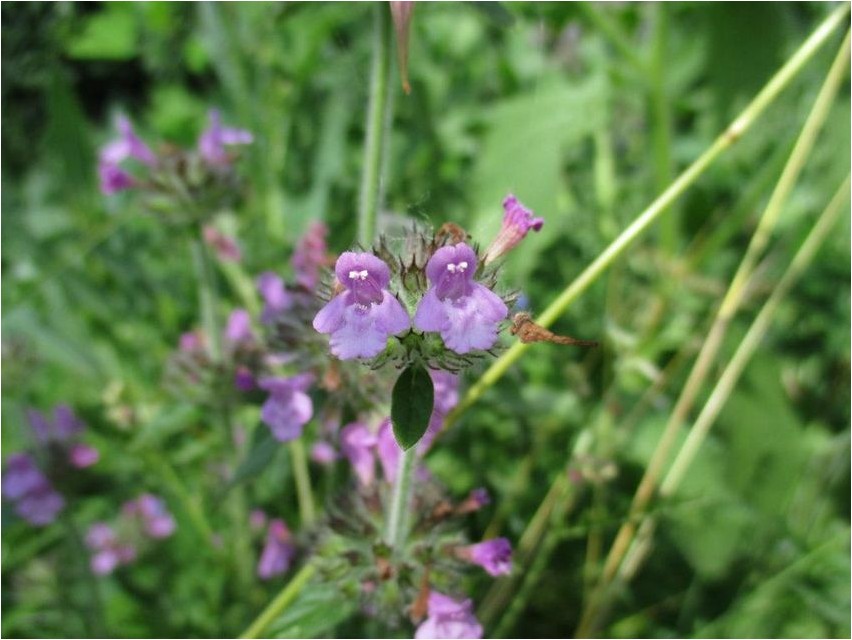
The common odoriferous plant is one of the plants of the family called Lamiaceae; in Latin the name of this plant will be as follows: Chinopodium vulgare L. (Calamintha vulgaris Druce).
As for the name of the common odoriferous family itself, in Latin it will be like this: Lamiaceae Lindl. (Labiatae Juss.).
Description of the common odorifera
Common odoriferous is known by numerous popular names: marsh babka, hair grass, woodwort, oregano-odora, gill, mashka, ribbed sword, serpentine, raschidnik, eryngium, sharushnik and horse garlic. Common odoriferous plant is a perennial herbaceous plant, endowed with an erect stem covered with soft hairs, and the height of such a stem will fluctuate between thirty and sixty centimeters. The leaves of this plant will be slightly serrated at the edges, they are ovate, and the bottom will be colored in pale green tones, while the apical leaves are bent down. The purple, two-lipped flowers of the common odorant will appear in quite a large number of whorls. Such flowers of this plant will be surrounded by subulate-linear and hairy bracts. The upper lip of the common odorant is flat, while the lower lip will be endowed with three petals. This plant has only four stamens, and the pistil will be equipped with a bipartite stigma. The ovary of the common odorant is superior and four-lobed, as well as four-lobed, endowed with a median style, which in turn will bear a bipartite stigma. The fruit of this plant, when ripe, will split into four nuts, which will be oval and almost spherical in shape.
Flowering odorifera occurs in the second half of the summer season. Under natural conditions, this plant is found in Belarus, Europe, Ukraine, the Caucasus and the European part of Russia. For growth, this plant prefers bushes, meadows, hills, forest clearings and light deciduous forests.
Description of the medicinal properties of the common odoriferous plant
Common odorifera is endowed with very valuable healing properties, and it is recommended to use the herb of this plant for medicinal purposes. The concept of grass includes the leaves, stems and flowers of this plant.
The presence of such valuable healing properties should be explained by the content of fragrant essential oil in this plant. Thanks to this, the common odorant will be endowed with a very effective astringent, anti-inflammatory, antispasmodic and antitussive effect.

As for traditional medicine, here this plant is very widespread. Here, an aqueous infusion prepared from the common herb is recommended for use for coughs, bronchitis, attacks of bronchial asthma, headaches, colitis, enterocolitis, diarrhea and dysentery. It is recommended to use poultices based on the herb of this plant as an anti-inflammatory agent.
For stomach cramps, it is recommended to use the following very effective remedy based on this plant: to prepare such a healing remedy, you will need to take one tablespoon of dry herb per 1 glass of boiling water. The resulting healing mixture should be infused for about thirty to forty minutes in a sealed container, after which this mixture should be filtered very carefully. Take the resulting healing remedy based on the common odor three to four times a day, two to three tablespoons. It should be noted that this healing remedy is very effective, and the positive result will be noticeable very quickly.





