Gulyavnik
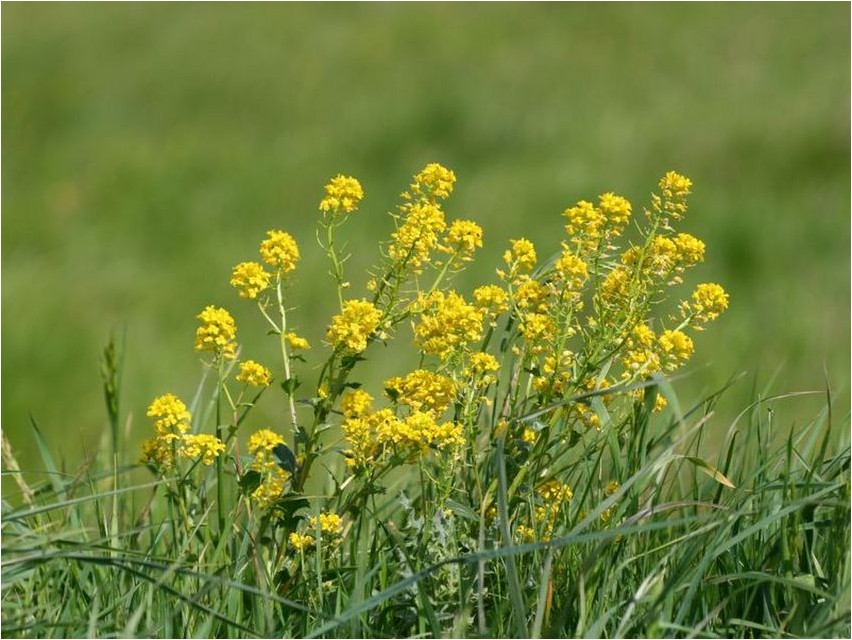
Gooseberry (lat. Sisymbrium) is a genus of herbaceous weeds of the Cabbage family (lat. Brassicaceae), many species of which have healing abilities.
Botanists divide plants of the Cabbage family into genera, the species of which are very similar in appearance, and therefore often the same plant has a long list of synonymous names that relate it to different genera of the family. For example, plant species of the genus Descurainia (lat. Descurainia), belonging to the Cabbage family, are often called “Walkers”. Since the similarity is often not only external, but also having the same healing abilities, such confusion is not too dangerous. Plants of the genus are distinguished by decorative, showy leaves and traditional small flowers with four petals, forming a miniature living cross.
What’s in your name
The genus received the Latin name “Sisymbrium” from Carl Linnaeus, who borrowed it from the Greeks, who became acquainted with plants of the genus several thousand years ago before Linnaeus decided to place all types of terrestrial plants on clear shelves. Unfortunately, a more detailed meaning of this Greek word has not reached our days.
The Russian name “Gulyavnik” may have been given to the plant for its independent and hardy nature, allowing the plant to freely “walk” through the uninhabited expanses of wasteland and fields, often turning into an annoying weed for cultivated plants.
Description
The branched root system gives birth to erect, branched, often pubescent stems, covered with spectacular carved leaves with a beautiful jagged edge. The height of plants, depending on the species and living conditions, varies from fifteen to fifty centimeters. The surface of the leaf blade can be bare or, like the stem, covered with hairs. The lifespan of different species varies and can be equal to one or two years, but some species manage to live for several years in one place, becoming perennial herbs.
Racemose inflorescences are formed by typical small flowers of plants of the Brassica family, having a green calyx of spaced or straight sepals, a corolla of four oblong-oval yellow petals and a brave pistil surrounded by six stamens.

The fruit is a traditional multi-seeded pod.
Varieties
Botanists do not have a consensus on the number of the Gulyavnik genus. Different sources offer a wide range, from fifty to ninety species. Here are a few types:
* Sisymbrium officinale (lat. Sisymbrium officinale)
* Volga gooseberry (lat. Sisymbrium volgense)
* Sisymbrium orientale (lat. Sisymbrium orientale)
* Yellow frogweed (lat. Sisymbrium luteum)
* Loesel’s frog (lat. Sisymbrium loeselii)
* Sisymbrium irio (lat. Sisymbrium irio)
* High frogweed (lat. Sisymbrium altissimum).
Uses and healing abilities
Some species, such as Sisymbrium loeselii and Sisymbrium altissimum, are readily eaten by ruminants while the leaves of the plant are young and green. During the period of seed ripening, plants become dangerous for animals to eat, since a toxic glycoside called “sinigrin” accumulates in the seeds.
Therefore, at the time of mature seeds, plants of the genus become attractive to traditional healers who know the rules for dosing toxic components in order to use plants to relieve a person from a number of ailments.
Decoctions and infusions of fresh plant herbs collected during flowering are used to treat respiratory diseases. Having an anti-inflammatory effect, they help faster healing of skin wounds. They are even credited with the ability to defeat cancerous tumors. These are the miracles that plants that grow everywhere and are classified by humans as weeds give people.
The fatty oil of the seeds, which has a pungent taste and a pungent, specific smell of mustard, turns the seeds of certain species of the genus into a mustard substitute.





