Aquatic soft-haired grass
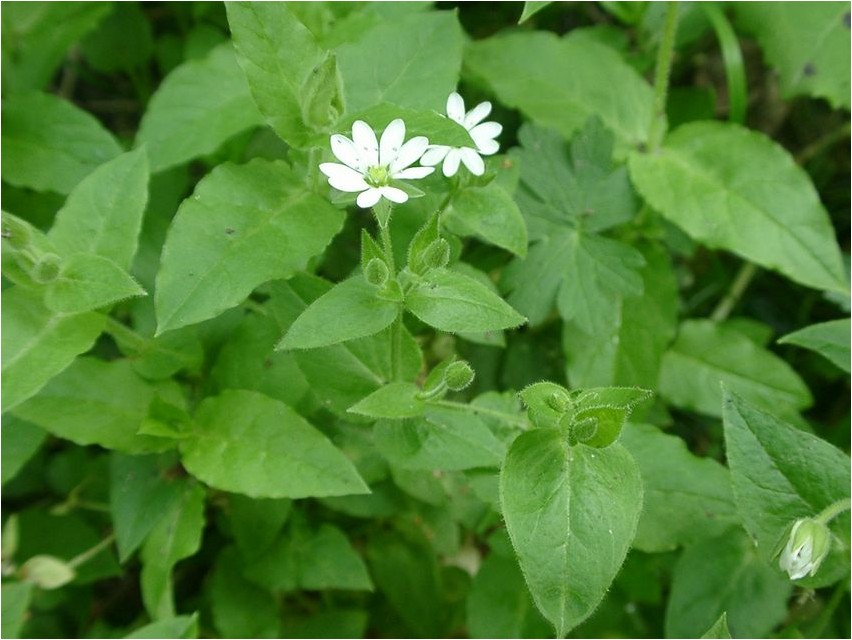
Water grass is one of the plants of the family called Cloveaceae; in Latin the name of this plant will be as follows: Myosoton aquatiqum (L.) Moench. (Malachium aquatiqum (L. Tries, Stellaria aquatica (L.)).
As for the name of the waterweed family itself, in Latin it will be like this: Caryophyllaceae Juss.
Description of the aquatic softhair
Water grass is a perennial herbaceous plant, the height of which will fluctuate between twenty and seventy centimeters. This entire plant in its upper part will be glandular-pubescent, and in the lower part it is bare. The stem of the waterweed will be erect and simple, however, most often it may be branched at the top. The leaves of this plant will be ovate, their length is three to eight centimeters, and their width will be about one to four centimeters. The upper leaves of waterwort are sessile, while the lower leaves will be on fairly short petioles. The inflorescence of this plant is a spreading semi-umbrella, while the bracts will be leaf-shaped and green. The length of the pedicels of this plant will be about one to two and a half centimeters, the petals will be painted white and they will be about one and a half to two times longer than the calyx itself. Watergrass seeds are dark brown in color and will be flat and rounded, kidney-shaped.
This plant blooms from July to November. Under natural conditions, the water grass is found in the European part of Russia, Ukraine, Belarus, the Caucasus, Central Asia, Kamchatka in the Far East, as well as in Western and Eastern Siberia. For growth, this plant prefers damp meadows, places along river banks and near ditches, and sometimes the plant can be found near housing.
Description of the medicinal properties of waterweed
Water grass is endowed with very valuable healing properties, and it is recommended to use the herb of this plant for medicinal purposes. The presence of such valuable healing properties should be explained by the content of the following flavonoids in this plant: auroside, vitexin, isoneoauroside, isovitexin, isoneovitexin, neovitexin, neoauroside and isoauroside.
As for traditional medicine, here healing remedies based on this plant have become quite widespread. An infusion prepared on the basis of the herb of the aquatic herb is recommended for use for eczema, various eye diseases, skin lesions and purulent inflammation of the throat.

For various skin diseases, eczema, blepharitis and conjunctivitis, it is recommended to use the following medicinal remedy based on this plant: to prepare such a medicinal remedy, you will need to take three tablespoons of crushed dry herb aquatic aquaticum in two cups of boiling water. It is recommended to infuse the resulting healing mixture for about one to two hours, and then it is very important to strain this mixture thoroughly. It is noteworthy that such a medicinal product based on aquatic hairs can also be used for gargling, and for all of the above diseases, lotions should be used. It should be noted that in order to ensure the greatest effectiveness when using such a medicinal product, it is very important to follow all the rules for its preparation, as well as to comply with all the rules for taking such a medicinal product based on aquatic hairs.





