Large rattle
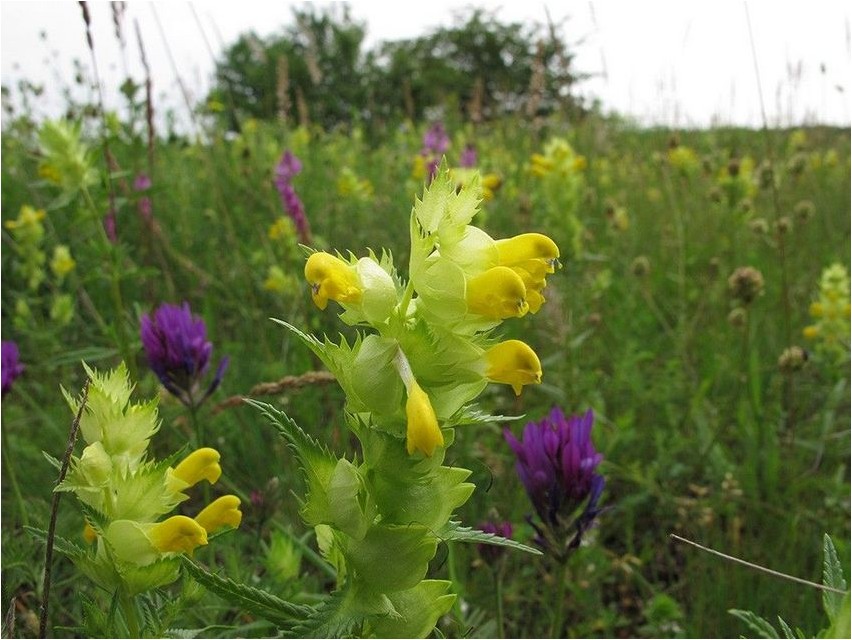
The large rattle is one of the plants of the family called Noricaceae; in Latin the name of this plant will be as follows: Rhinanthus alectorolophus (Scop.) Pall. (R. major L.).
As for the name of the large rattle family itself, in Latin it will be like this: Scrophulariaceae Juss.
Description of the big rattle
The large rattle is an annual herbaceous plant, the height of which will fluctuate between thirty and fifty centimeters. It is noteworthy that this plant is a semi-parasite. The stem of the large rattle will be colored in green tones or may be endowed with longitudinal purple lines, and may also be branched or simple. The lower leaves of this plant are oblong-ovate, while the upper leaves will be narrower and lanceolate. The inflorescence most often begins at 5-6 nodes. The length of the corolla of the large rattle is about two centimeters, while the tube will be compressed and curved, and the nose of the upper lip is horizontal, its length is two millimeters. This nose can be painted either purple or white. The lower lip is pressed against the upper lip, and the mouth of the corolla itself will be closed. The width of the seed and wing of the large rattle is one millimeter.
The flowering of the large rattle occurs in the period from June to July. Under natural conditions, this plant is found in Moldova, Belarus and the Carpathians in Ukraine. For growth, this plant prefers forest clearings, meadows and river valleys. It is noteworthy that the large rattle is not only an insecticide, but is also a poisonous plant.
Description of the medicinal properties of the large rattle
The large rattle is endowed with very valuable healing properties, and it is recommended to use the grass and leaves of this plant for medicinal purposes. The concept of grass includes the leaves, stems and flowers of this plant.
The presence of such valuable healing properties is recommended to be explained by the content of tannins, vitamin C, steroids, steroid saponins, iridoids, cardenolides, essential oil and carotenoids in this plant. At the same time, fatty oil will be present in the seeds of this plant.

Preparations made from the herb of the common rattle are used for scrofula, while dried crushed leaves of this plant are used for purulent wounds, and rubbing it with honey is a very effective preventative measure against hypothermia. A decoction of this herb should be taken internally for alcoholism.
It should be noted that the common rattle has both insecticidal and antibacterial properties. The seeds of this plant are used to make a purple dye.
For the treatment of alcoholism, the following highly effective remedy based on this plant is recommended: to prepare this remedy, add one teaspoon of crushed common rattle leaves to two cups of boiling water. The resulting healing mixture should be steeped for approximately thirty minutes, after which it is recommended to strain it very thoroughly. Take the resulting medicinal remedy, made from crushed leaves of the greater rattle, one glass in the morning on an empty stomach for approximately seven to ten days.





