Larkspur (Delphinium grandiflorum)
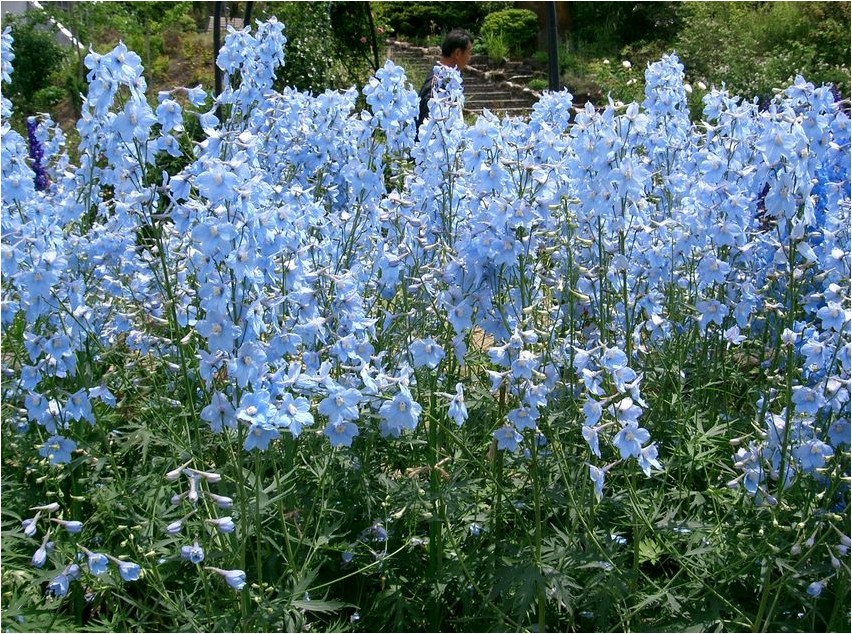
Larkspur (Delphinium grandinorum) is a member of the buttercup family. Its Latin name is Delphinium grandinorum L.
The family name of Larkspur is Ranunculaceae Juss.
Description of Larkspur
Larkspur (Delphinium grandiflorum) is a perennial herbaceous plant, reaching a height of between fifteen and seventy centimeters. The stem is more or less branched at the top and covered with short, appressed hairs. The leaves are broadly kidney-shaped, reaching up to ten centimeters in length and up to fifteen centimeters in width. The leaves are bipalmately dissected, with narrow linear segments and shortly pubescent on both sides. The flowers are one to two centimeters in diameter, oblong in shape, and shortly pubescent on the outside. They are dark blue in color.
Larkspur blooms in the second half of summer. It prefers open, south-facing slopes, dry meadows, fallow lands, river valleys, and steppes. In the wild, this plant can be found in the Altai Mountains, western Amur Region in the Far East, and in the following regions of Eastern Siberia: Dauria, Angara-Sayan, and Lena-Kolyma. It is noteworthy that the plant is both an insecticide and an ornamental plant.
Description of the Medicinal Properties of Larkspur
Larkspur possesses valuable medicinal properties, which are explained by the plant’s content of alkaloids, coumarins, flavonoids, and tannins. The flowers of this plant also contain flavonoids and tannins.
In folk medicine, an infusion of the herb is widely used, recommended for gastrointestinal ailments, dysentery, typhoid fever, jaundice, ringworm, pancreatic and eye diseases, as well as infected wounds, gastroenteritis, and pediculosis. The plant has antibacterial and hypotensive properties.

It should be noted that in China, the root of this plant was used to reduce toothache. A decoction of the herb or an alcoholic extract of this plant is used to kill lice. It is important to remember that this plant is poisonous, for this reason you should be careful when taking products based on Larkspur grandiflora. It is noteworthy that the plant can even cause poisoning of sheep and cattle on grazing. In case of poisoning of animals, gastric lavage should be performed, and emetics and a saline laxative should be taken. If breathing stops, artificial respiration is recommended.
For gastroenteritis, you should use an effective remedy based on this plant: to prepare such a remedy you will need to take twenty grams of dry crushed herb per liter of boiling water. The resulting mixture should be infused for one hour, and then this mixture is filtered very carefully. Take this remedy based on Larkspur grandiflora, one third of a glass or half a glass three to four times a day. It should be noted that this remedy can be used not only for gastroenteritis, but also for pancreatitis and jaundice. To maintain greater effectiveness, you should follow all the rules for preparing and taking such a product.