Wangeria
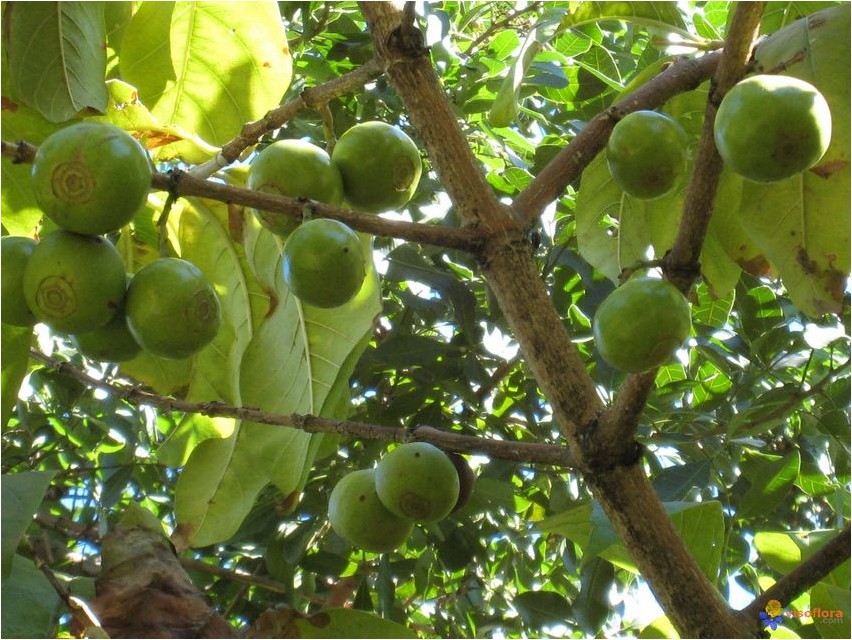
Vangeria (lat. Vangueria) is a fruit plant belonging to the Rubiaceae family.
Description
Wangeria is a small deciduous tree, endowed with a grayish-yellowish-brownish crown and reaching a height of three to seven meters. The crown of the trees is incredibly branched and very, very dense.
In most cases, elliptical or oval leaves of Wangeria are located separately. Young leaves are usually very tender, while older leaves are always quite hard and rough.
Wangeria flowers are collected in compact inflorescences and are distinguished by a greenish-whitish or pleasant yellowish color.
The shiny fruits of this crop have an almost round shape; unripe fruits are usually dark green, and ripe fruits are colored light brown or brownish. Whole ripe vangeria is edible and very soft — it has a pleasant sourish-sweet aftertaste. And inside each fruit you can find four seeds.
Where does it grow
Most often you can meet Wangeria in the South African savannahs. This crop is also grown in Namibia, Botswana, and also on the island of Madagascar. Wangeria grows very well in thickets of various bushes and in numerous forests, taking root on both rocky and sandy soils without much difficulty. By the way, in the countries of South Africa, these unusual fruits are very popular — in the leanest years they save the large local population from imminent death by starvation.

Application
The fruits of the beautiful vangeria are eaten fresh, and they are also used to make jam, jelly and jam with juices. These fruits are also good in dried form — they are used in the same way as all other dried fruits. In addition, excellent brandy is often infused on the fruits of this plant. And if you subject them to fermentation and subsequent distillation, you can get very original beer. If you mix the fruits with sugar and then ferment them, you will get vinegar, somewhat reminiscent of apple cider vinegar.
The leaves and roots of this plant have healing properties. An infusion prepared from them is actively used as a means to relieve edema, as an analgesic and delicate laxative, as well as for the treatment of malaria and a number of bronchopulmonary ailments (including pneumonia). Wangeria also helps to cure skin diseases or intestinal ailments. A decoction of leaves and roots is often added to water intended for bathing children. Also, the leaves of this plant are often used as one of the components of toothpastes.
The carbohydrate-rich fruit pulp is highly nutritious — its systematic consumption helps to quickly restore strength after serious physical exertion. These fruits also contain a lot of vitamins, due to which vangeria has a tonic and pronounced immunostimulating effect on the body. And regular consumption of miraculous fruits has a beneficial effect on the state of the nervous and cardiovascular systems.
Contraindications
Wangeria is a fruit that has not been fully studied, so no contraindications to its use have been identified at the moment. However, due to the fact that these fruits are still exotic, the possibility of allergic reactions cannot be completely ruled out.
Growing
Wangeria is characterized by cold and drought resistance, which allows it to be grown even in a temperate climate zone. Quite often, this plant is grown in gardens and as a houseplant — its high decorative qualities have long attracted gardeners and plant growers.
The bushy trunks of the unpretentious vangeria can be formed without much difficulty. It is especially convenient to form them in the first years of life. Often this crop is planted to prevent possible soil erosion (that is, weathering of a valuable fertile layer or its removal by floods), as well as to curb the growth of ravines and the gradual spread of sand.





