Drooping lumbago
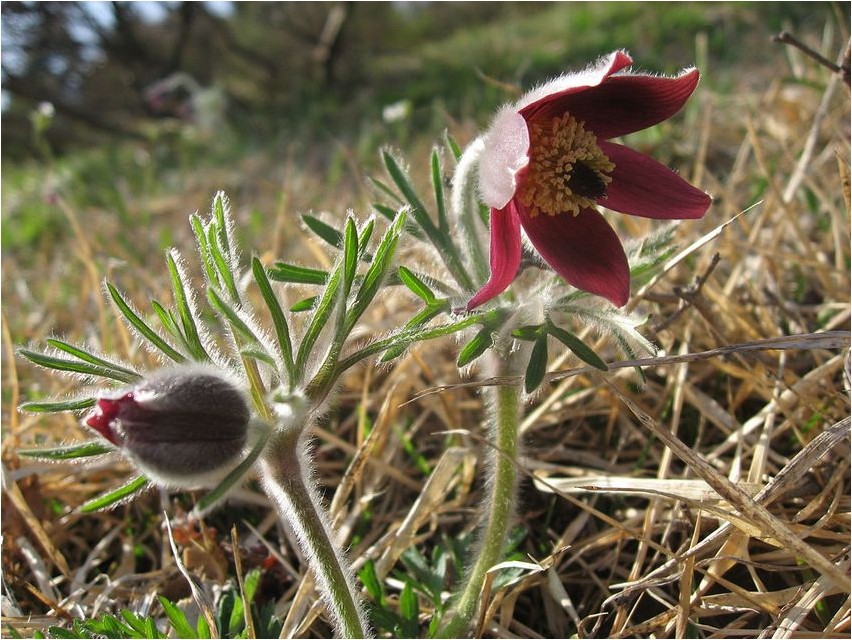
The drooping lumbago is one of the plants of the family called Ranunculaceae; in Latin the name of this plant will be as follows: Pulsatilla cernua (Thunb.) Bercht. ex Opiz. (Anemone cernua Thunb.).
As for the name of the drooping lumbago family itself, in Latin it will be: Ranunculaceae Juss.
Description of the drooping lumbago
The drooping lumbago is a perennial herbaceous plant, the height of which can reach twenty centimeters. This plant will be endowed with rather large flowers, the length of which will be about three centimeters, and they will be colored in crimson or violet-red tones. In most drooping lumbago leaves, the middle lobe of the leaves is endowed with three more or less identical teeth at the end.
Under natural conditions, this plant is found in the following regions of the Far East: Primorye and Amur region. For growth, drooping lumbago prefers dry slopes and turfed river sands.
Description of the medicinal properties of drooping lumbago
Drooping lumbago is endowed with very valuable healing properties, and it is recommended to use the roots and grass of this plant for medicinal purposes. The term grass includes leaves, stems and flowers.
The presence of such valuable medicinal properties is recommended to be explained by the content of sitosterol, coumarin, hederagin, saponins, stigmasterol, gamma-lactones protoanemonin and anemonin, as well as the following acids: acetyoleanoic and oleanoic acid.

As for traditional medicine, here this plant is quite widespread. Traditional medicine recommends using a decoction prepared from this plant as a hemostatic, anti-inflammatory and astringent for polymenorrhea, amoebic and bacterial dysentery.
An infusion and decoction prepared from the herb of lumbago is indicated for use as a very effective antifebrile agent for various fevers, edema of cardiac and renal origin. In the form of mustard plasters, an infusion based on the flowers of this plant is used as an analgesic, antipyretic and tonic for a variety of colds that are accompanied by cough and aches. An infusion prepared from fresh flowers of lumbago should be applied as compresses to sore joints in case of arthritis.
It should be noted that in the Far East, drooping lumbago is quite widely used for various diseases of the joints, and it is recommended to keep diseased limbs over the steam that comes from boiling water with the addition of the herb of this plant.
For skin diseases, the following healing remedy based on this plant is considered quite effective: to prepare such a healing remedy, you will need to take ten grams of crushed dry leaves of lumbago drooping in about one full glass of cold water. It is recommended to first infuse the resulting medicinal mixture based on the leaves of this plant for about twenty-four hours, after which the mixture should be filtered very carefully. The resulting healing remedy based on lumbago drooping is taken externally for a number of skin diseases. It is important to note the fact that in order to ensure maximum effectiveness when using such a healing remedy, you should both strictly follow all the rules for preparing this remedy based on drooping lumbago, and carefully observe all the rules for its use.





