Jambolan
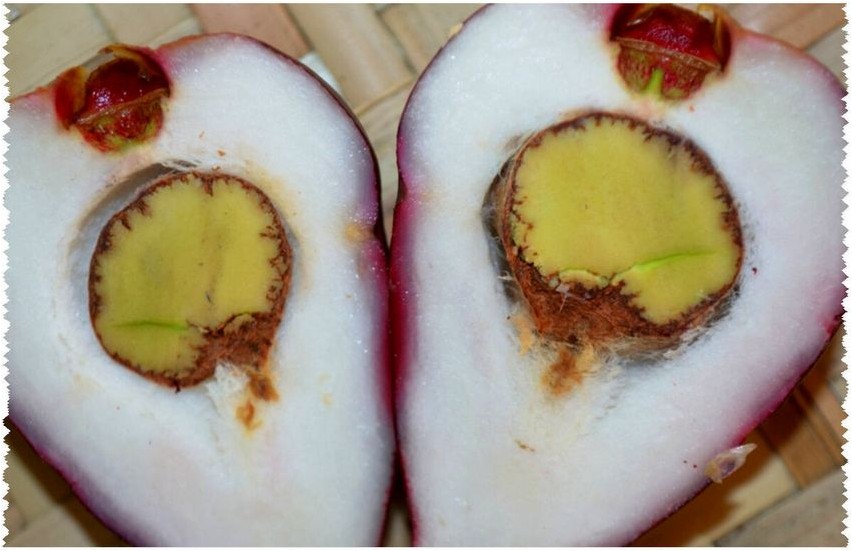
Jambolan (Latin: Syzygium cumini) is a fruiting plant belonging to the Myrtle family. It”s worth noting that the water apple is also sometimes called the water apple; however, despite some similarities, these plants are actually completely different species.
Description
Jambolan is a fast-growing, evergreen tree growing up to thirty meters tall, with trunks reaching ninety centimeters in diameter.
Ripe jambolan fruits are dark purple, almost black drupes, ranging in diameter from one to five centimeters. Unripe drupes are initially green, then, as they gradually ripen, they turn red, and only then do they turn black. The flesh of jambolan fruits can vary greatly in color, from white to a striking bright purple. The surprisingly juicy flesh has a surprisingly pleasant, rather sweet, aroma. The pulp”s flavor is typically astringent and slightly bitter. Each drupe contains either one or several green or brown seeds.
The berries hang from the trees in fairly large clusters, and even the slightest breeze causes them to fall.
Where it grows
Jambolan is a fruit native to the Andaman Islands, as well as Myanmar, Sri Lanka, and India. It is also primarily cultivated there. Significant jambolan plantations can also be found in Australia, the Philippines, East Africa, and Indonesia, as well as in tropical America.
Uses
Jambolan fruits are often eaten fresh. They are also used to make sherbets, jellies, puddings, cakes, sauces, ice cream, syrups, and even vinegar. To reduce the berries” astringency, they are soaked for a while in lightly salted water.

These interesting berries are rich in resins, tannins, and pectin (valuable to many cooks), along with beneficial microelements, organic acids, and vitamins. Jambolan has astringent properties and is excellent for lowering blood sugar (despite the relatively high sugar content of the fruit itself).
For medicinal purposes, not only the fruits are used, but also the bark, leaves and seeds of jambolan. The berries boast a pronounced diuretic, carminative, astringent, as well as gastric and antiscorbutic (they contain a lot of ascorbic acid) effect. As a rule, juice is squeezed out of the fruits or they are boiled — this allows you to get a very unique drink, very useful for an enlarged spleen, as well as for urinary retention and extremely unpleasant chronic diarrhea. And the diluted juice is used to gargle with a sore throat.
Dried, ground jambolan seeds will be excellent helpers for diabetes, and juice squeezed from its leaves, combined with mango juice, will help cure dysentery. As for the bark decoction, it will help with periodontal disease, stomatitis, dyspeptic disorders, bronchitis and asthma.
It is noteworthy that the leaves of this plant are also eaten by livestock with pleasure — the whole point is that they are highly nutritious food.
Since time immemorial, jambolan wood has been used in shipbuilding, as well as in the production of all kinds of decorative items, furniture and a number of musical instruments. And excellent dyes, including food ones, are obtained from the bark. In addition, it is very rich in tannins, which makes it possible to use it for tanning leather, as well as for impregnating fishing gear — the latter in this case acquire a characteristic camouflage color and stop rotting.
Contraindications
In case of exacerbation of various ailments of the gastrointestinal tract, it is strictly not recommended to consume jambolan berries. Individual intolerance cannot be ruled out.
Growing and care
Despite the fact that jambolan is very thermophilic, it can be found at an altitude of up to two thousand meters above sea level, however, it no longer grows above the thirtieth degree of southern and northern latitudes. This culture is extremely partial to abundant watering and is propagated by seeds.





