Wax gourd
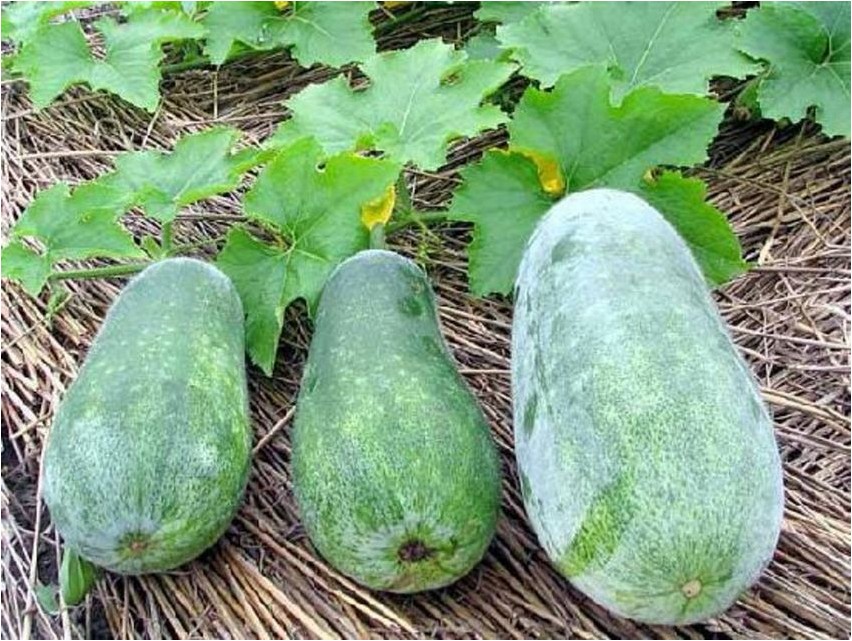
Wax pumpkin (lat. Benincasa hispida) is a representative of the Benincasa genus of the Pumpkin family. Other names include winter melon or winter squash. The homeland of the plant is considered to be South and East Asia.
The wax gourd is rare in the wild. Currently cultivated in India, Pakistan, Vietnam and China. In Russia it is grown only on personal plots.
Characteristics of culture
Wax gourd is a fast-growing herbaceous vine with stiffly pubescent shoots. The leaves are heart-shaped, 5-7-lobed, wavy, long-petiolate, serrated along the edge. The flowers are large, golden yellow, fragrant. Wax pumpkin blooms in July. The fruits are oval, white or light green with a waxy coating, up to 35 cm long.
Subtleties of cultivation
Wax pumpkin prefers light, moderately moist, permeable soils with a pH of 5. 8-6. 8. The location is preferably sunny. In dense shade, plants practically do not bloom and often rot. The best predecessors are all types of cabbage, potatoes, carrots, beets and legumes. It is not recommended to plant the crop after representatives of the Pumpkin family.
Wax pumpkin is grown mainly in seedlings. Sowing is carried out in late April — early May. The seeding depth is 1-2 cm. The seedlings are regularly watered and fed with liquid mineral fertilizers. At the age of 20-25 days, the seedlings are transplanted into open ground under cover; in June the cover is removed. The distance between plants should be about 35-40 cm, and between rows — 60-70 cm.
Wax pumpkin is relatively drought-resistant, but requires systematic watering with warm and settled water, especially during the fruiting phase. During the growing season it is necessary to carry out two feedings. As fertilizers, the use of ammophos (30-40 g per 1 sq. m), ammonium nitrate (15-20 g per 1 sq. m) and potassium sulfate (20-25 g per 1 sq. m) is not prohibited.

Wax gourd flowers are pollinated by insects, but artificial pollination is also encouraged. Plants require formative pruning, which consists of removing side shoots to a length of 1 m. Up to 4-5 fruits are stored on the plant. Since the fruits of the crop are heavy, the plants must be tied to a support.
Application
The fruits of the wax pumpkin have a sweetish pulp with a slight sourness. They are used to prepare salads, soups, cereals, drinks and pie fillings. The leaves, shoots and tendrils of the plants are also edible and are widely used in folk medicine. Wax gourd has diuretic, anthelmintic, laxative, antifever, adaptogenic, antifever and aphrodisiac properties.
Wax gourd is useful for treating diseases of the nervous system, sexually transmitted diseases and as an appetite enhancer. In China, national pies and mooncakes are made from pumpkin, which are especially relevant during the autumn holiday. In Pakistan, wax gourd fruits are used to make sweets. Residents of this country believe that plant seeds soaked in milk increase the number of sperm and increase their activity.





