Krasnik
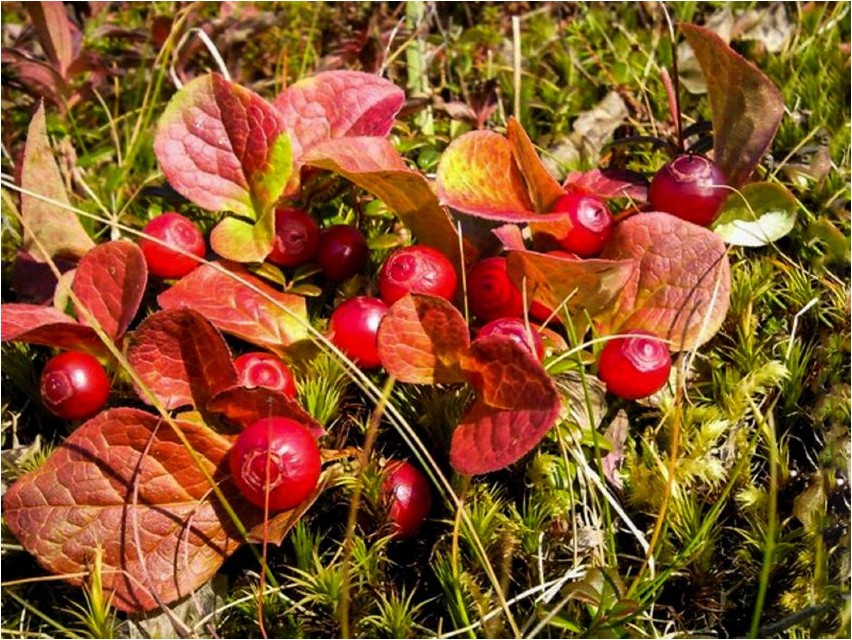
Krasnika (lat. Vaccinium praestans) is a subshrub or shrub of the genus Vaccinium of the Heather family. Other names are vaccinium excellent, bedbug or bedbug.
In nature, redberry is found in Kamchatka, Sakhalin, the Kuril Islands, Hokkaido and Honshu. Typical habitats are moss swamps, spruce and fir-deciduous forests and slopes with a developed moss cover. The plant is considered food, medicinal and ornamental at the same time.
Characteristics of culture
Krasnika is a small subshrub with a horizontally lying stem covered with moss and rising, heavily leafy branches with yellowish-gray bark. The leaves are thin, harsh, rounded or obovate, narrowed towards the base, finely serrated along the edges, 2-6 cm long, 3-3. 5 cm wide. The flowers are pink, bell-shaped, collected in small racemes. The calyx consists of 4-5 wide ciliated teeth of a triangular shape. The corolla is pale yellow, up to 0. 6 cm long.
The fruits are spherical, large, bright red, very juicy, have a sweetish-sour taste and a specific smell. The size of the berries largely depends on the growing conditions. Larger berries are found primarily in wetlands, while smaller ones are found in open, sunny areas with dry soils. The redberry blooms in June-July, the fruits ripen in August-September. There is no varietal redberry yet, but the available forms differ from each other.
Growing conditions
Krasnika is a shade-loving crop, but when grown in garden plots, it needs sunlight. Again, this rule applies only with regular and abundant hydration. If the gardener does not have the opportunity to constantly water the plants, it is better to plant them in shaded areas. Soils are preferably acidic, loose, air-permeable and moisture-absorbing. Other soil substrates inhibit plants, reducing their winter hardiness and the amount of yield. In some soils, plants rot and die. The best option, which can be recreated in any garden plot, is a substrate consisting of fertile soil, peat and sand in a ratio of 1:3:1.
Reproduction
Redberry is propagated by seeds and division of rhizomes. A healthy bush is dug out with a shovel, divided into several parts and immediately planted in holes. The soil of the plots is compacted, watered abundantly and sprinkled with peat. The seed method is also effective, but rather labor-intensive than the vegetative method. Seeds are sown in autumn, in which case they undergo natural stratification. If planting is planned in early spring, then the seeds are kept in the snow for three months. In this case, the germination percentage of redberry increases to 70%.

It should be remembered that freshly harvested seeds should not be used. It is better to use seeds that have been stored for at least a year. The area for growing redberry is prepared in advance: the soil is dug up, rhizomatous weeds are removed and double superphosphate (40 g) and potassium sulfate (20 g) are added. A trench 50-80 cm wide is formed on the ridges, and pieces of linoleum, plastic and polyethylene are laid around. This approach will prevent the appearance of weeds. Peat and sand are poured into the trenches. And only after that young bushes are planted.
Care
Krasnika needs regular and abundant watering, although stagnation of water should not be allowed. During drought, the volume of water and the number of irrigations increase. Weeding and feeding with peat are also important. Peat is added in the fall along with double superphosphate (about 15-20 g per 1 sq. m.).
Krasnika has a positive attitude towards fertilizing with nitrogen and potassium fertilizers. This feeding is carried out twice: the first — in early spring after the snow melts, the second — during flowering. In winter, plants are mulched with healthy fallen leaves, peat or sawdust.