Tiss
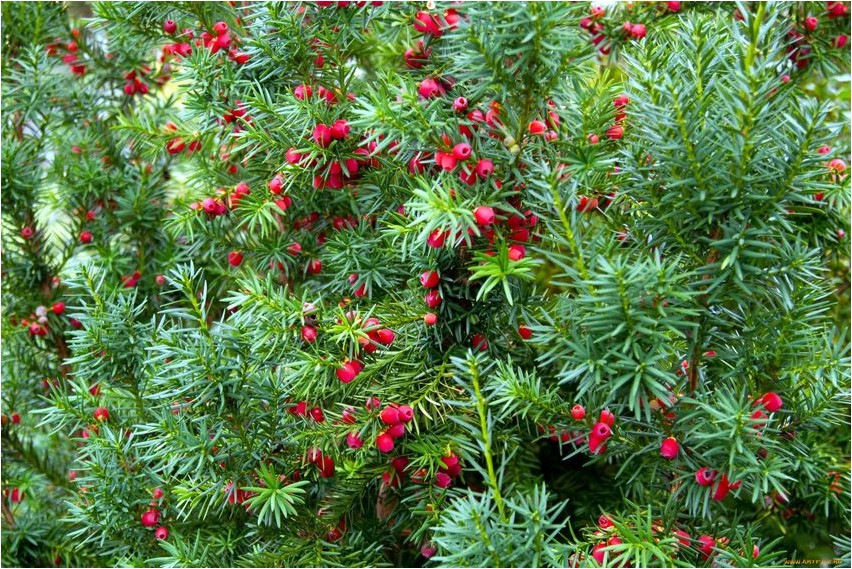
Yew (lat. Taxus) is a light-loving woody coniferous plant belonging to the yew family of the same name.
Description
Yew is an incredibly spectacular dioecious tree or shrub with scaly bark of reddish or reddish-brown shades. Trees are usually medium-sized, from one to two meters high, and shrubs are usually low-growing — their height rarely exceeds one meter. However, sometimes you come across real giant trees — the height of some of them sometimes reaches twenty-seven meters, and the diameter of yew trunks can sometimes reach one and a half meters! On the upward-directed shoots of yew, the leaves are arranged spirally, and the horizontal shoots are covered with linear, almost comb-like, double-rowed and sometimes crescent-shaped leaves.
In total, the yew genus has about eight to ten species. But the origin of the name of this plant, alas, is still unknown to anyone. By the way, yew is a very ancient and quite rare tree, which is why it was listed in the Red Book. At the same time, Fortingall yew is considered one of the oldest yew trees in Europe — according to one of the legends, Pontius Pilate spent his childhood under the shade of this mighty tree growing in Scotland.
Where does it grow
In Russia, only two species of yew grow wild. Moreover, this tree grows equally well both on plains and in forests (both in the undergrowth and in the forest stand). And in the mountains, yew can rise to a height of up to two thousand meters above sea level!
Usage
The high decorative value of yew, especially berry yew, makes this plant a favorite option for use in landscape design. And when creating classic English gardens, this is generally the most common ornamental tree! As for clipped yews, they are excellent for creating not only picturesque hedges, but also all kinds of decorative ornamental figures — cubes, balls and a wide variety of sculptures.
A substance called taxol is obtained from yew, which is widely used in the treatment of various oncological diseases. And its wood is very actively used both in construction and in turning or carpentry, as well as for finishing various musical instruments and furniture.

Almost all parts of yew are poisonous — this applies to its bark, young shoots, needles, and even seeds, and this fact cannot be discounted in any case!
Growing and care
Despite its impressive shade tolerance, yew will also thrive in sunny areas, but in all cases it will need to be provided with reliable protection from the wind. This plant prefers soils that are fresh, but at the same time not waterlogged, ideally containing lime (garden soils are especially suitable for growing it), and yew needs moist air.
Every two years it is recommended to feed the yew with high-quality mineral fertilizers — if possible, this should be done in May.
The yew tolerates severe pruning and cutting very well, so these manipulations can be carried out without any fear. And for the winter, it is recommended to tie young plants into bunches (not forgetting that their branches are quite fragile!), mulch them with peat and thoroughly cover them with spruce branches. In the conditions of the middle zone, yew is quite winter-hardy, but in some winters its shoots can still freeze.
Yew can be propagated using cuttings or seeds. At the same time, it doesn’t hurt to know that the root collar should not be buried when planting.